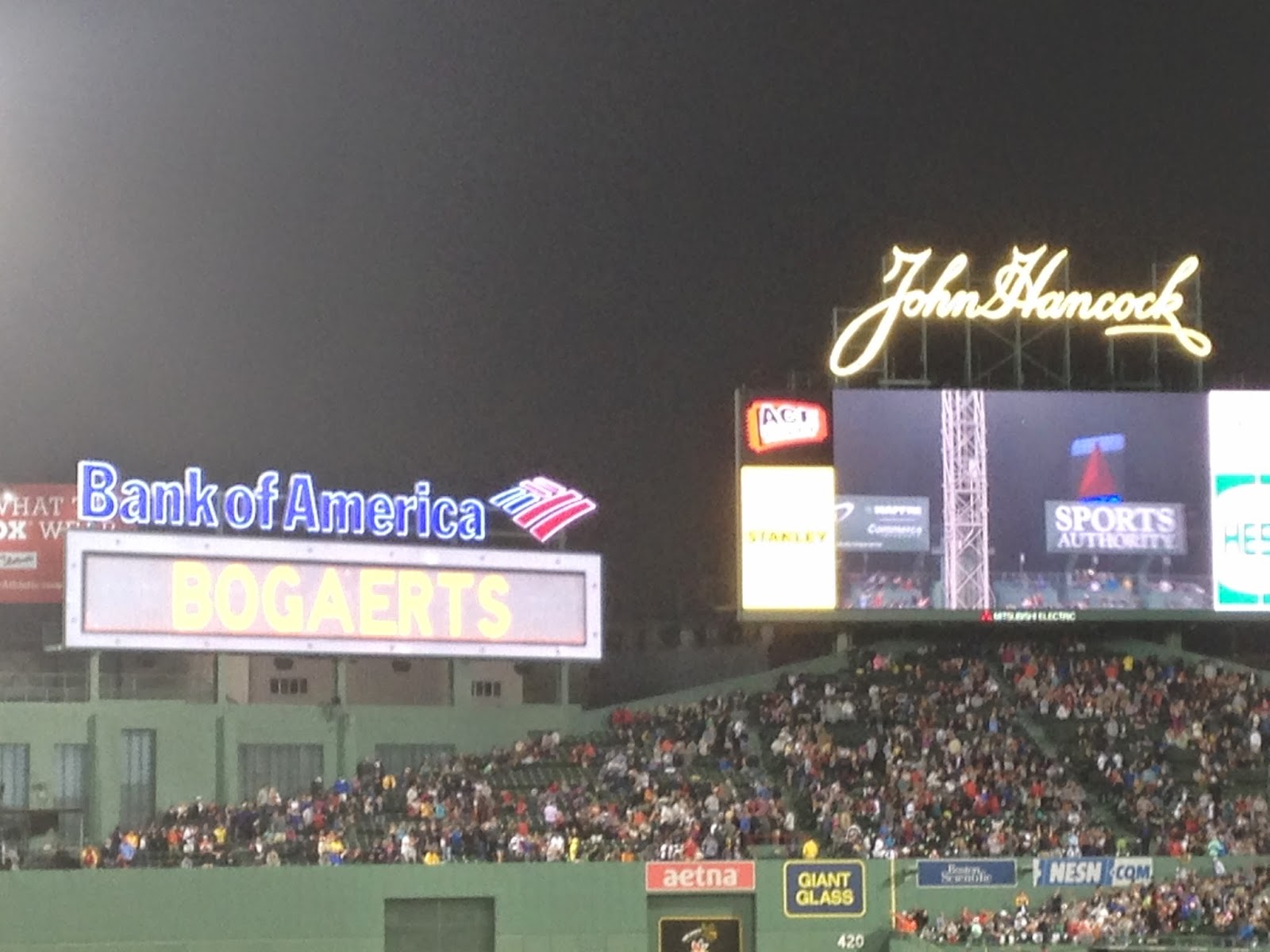
Thursday, June 26, 2014

"Miracle at Fenway" Excerpt: Running Man

Roberts in the moment. 

My latest book, "Miracle at Fenway: The Inside Story of the Boston Red Sox 2004 Championship Season" will be available nationwide on July 15 (and can currently be pre-ordered online). In advance of its release, I will be running excerpts here over the next several weeks.


The first thing he thought about was Maury Wills. 

In this, the biggest moment of his baseball life, Dave Roberts was trying to focus on the topic at hand. It was the ninth inning of Game 4 of the American League Championship Series, the Red Sox trailed, 4-3, and Roberts stood on first base representing the tying run. 

If the Sox lost, their season was over; the Yankees led the best-of-seven series three games to none, and were set to celebrate on the Fenway Park grass after just three more outs. They had the right man on the mound to get those outs in Mariano Rivera, the greatest closer of his or any generation.

The home fans were abuzz, urging on a Boston rally, but Roberts could not hear them. Inserted into the game moments earlier as a pinch runner for Kevin Millar, whose leadoff walk against Rivera had raised the masses to their feet, Roberts knew it was his feet that everybody in the ballpark and millions of TV viewers were now watching. 
Mo in October: usually automatic. (New York Post)

He was a reserve outfielder who had not played in a week, and he had been put in here for one reason: to steal second base and give the Red Sox a chance to tie the game on a single. The crowd knew it, the TV and radio analysts were pontificating on it, and the cameras were bracing for it -- zoomed in and ready to capture the moment.

Roberts could feel the sense of urgency, could anticipate the eyes upon him. Still, poised on the grandest of stages, he had the clarity to think back 10 months to moments in a near-empty ballpark 3,000 miles away. Moments spent with Maury Wills.

Wills was a baserunning instructor for the Los Angeles Dodgers, for whom he had once set the major league record with 104 stolen bases in a single season. Now in his 70s, slower afoot but richer in experience, he had worked with Roberts at Dodgers Stadium over the previous winter on the art of the perfect steal.

There will come a time, Wills had imparted, when you will be called upon to swipe a bag without the art of surprise in your arsenal. A quartet of defenders will be poised to stop you. The pitcher, sure you’ll be running, will be keeping you close. The catcher will be ready to take the pitch and whip it to second. The shortstop will be moving to second with the pitch, ready to receive the throw from the catcher and apply the tag. And the first baseman will be tight on the bag, in case you stray too far and there is a chance for the pitcher to gun the ball over and pick you off. 

Wills in '62: Advice from an expert

In such a situation, Wills told his protégé, you’ll need to first get a big lead, and then rely on everything you’ve learned about the pitcher’s tendencies: his windup, his release point, and any moves he might make to warn you he’s ready to spin and make a pickoff throw. Roberts followed the advice. He watched video of all the Yankee pitchers, studied many of them live, and in the case of Rivera and New York catcher Jorge Posada already had some firsthand success to build on. A few weeks before, in the waning days of the regular season, Roberts had stolen second against this All-Star battery and scored the tying run in an eventual Red Sox win.

The big difference, of course, was that this was the playoffs, and an elimination game at that. If Posada gunned Roberts down here, or, worse yet, if Roberts guessed wrong on his initial jump toward second and was picked off, it could mean Boston’s season. Roberts felt his anxiety level rising, but then he remembered something else Wills had told him: You can’t be afraid to steal that base.

I might not be afraid, Roberts remembers thinking to himself, but I am most definitely nervous.

“The game felt like it was going very fast; my mind was racing,” Roberts recalls nearly a decade later. “I've got a big lead, but to just go out there and steal, it’s pretty tough. I know what Mariano is going to do; I’ve got the information. I’m getting as loose as I possibly can, but this is October, and it’s cold.”
Bill Mueller: the ultimate dirt dog

The next batter, Bill Mueller, stepped into the box. Rivera set, and then, just before starting his windup, quickly spun and threw over to first baseman Tony Clark in a pickoff attempt. Roberts dove back to the bag just before Clark slapped him with his glove. In that moment, and the one that quickly followed it, the base runner felt a change come over him.

“I think you can actually see it in the footage,” says Roberts. “He throws over one time, and my nerves start to calm. The game starts to slow down. Then he throws over a second time, and he almost gets me, which is great because for me it slows the game down even more.  My focus started to get even better – at that point it felt like I was a part of the game.”

Roberts thought of something else as he dusted himself off a second time: maybe the pitcher was as nervous as him. Rivera possessed outstanding control; he almost never walked anyone, let alone the leadoff man in an inning. His ability to coolly put games to bed for the Yankees had earned him the nickname “Sandman” around the league, and while Rivera's cool exterior did not hint at it, Roberts hoped that Millar's base on balls might have rattled the unflappable pitcher just a bit.
Millar works a walk. (FOX TV)

There was also recent history to consider. In addition to the September victory in which Roberts had a key steal, the Red Sox had beaten Rivera in July as well on a walkoff home run at Fenway by the same man now at the plate – Bill Mueller. Roberts hoped all these things were on Rivera's mind; if they were, it might give him a bit more of an edge was he to try for second.

The only thing Roberts knew for sure was this: eventually Rivera was going to have to deliver a pitch to Mueller. The question was when. Throughout Fenway Park, and beyond, fans watching the game on NBC or listening to the play-by-play of Red Sox broadcasters Joe Castiglione and Jerry Trupiano wondered as well.  Joe Morgan, the former Red Sox manager who had lived and died with the team for his entire 74 years, leaned forward in his basement sofa and stared at the TV – trying like Roberts to read Rivera’s mind. 

So did Fenway vendor Rob Barry, a former Northeastern University pitcher who had achieved his own bit of glory as the ballpark’s premier peanut-bag tosser. From his current spot in the box seats just behind Boston’s dugout, Barry had a perfect view of both Roberts in profile and the broad back of the right-handed Rivera -- with its familiar black 42 first made famous by fellow legend Jackie Robinson.
Rob Barry: the perfect view

A moment later, the number blurred as Rivera spun once more and threw to first. Again Roberts lunged back, and as he got to his feet a third time he felt confidence surging through him.

“Now it felt like I had played all nine innings,” Roberts remembers with a smile. “My legs felt like they were ready to go, and I could fire to get a great jump. If he wanted to go to the plate, I had him. I knew I had him. If he had just thrown to the plate without throwing over, I don’t know if I could have felt [capable of getting] a great jump. But then, just from all the diving back, I felt like, 'I’ve got you now.'”

Just wait him out, Roberts said to himself. A moment later, as Rivera finally began his full windup – indicating he was going to throw home to Mueller – Roberts took off, head down and arms pumping, for second base.

The pitch was a fastball away, considered ideal for a catcher in terms of nabbing would-be base stealers.  Mueller didn’t swing, and as the ball slammed into Posada’s glove he was already leaping up to unleash his throw towards second. It was near-perfect, and a slightly crouching Jeter grabbed it just to the left of the bag and then in a fluid motion swept down his left arm into Roberts’ left shoulder as he dove in headfirst.

It was so close a play that for an instant nobody could tell whether Roberts had made it. Posada ripped off his mask and stared out at second base umpire Joe West, and Jeter and Roberts lifted their heads to do the same. Ron Barry, Joe Morgan, and everybody else watching live, in bars, or at home held their collective breaths – knowing that if Roberts was called out, the Red Sox would be all but out as well.

Then West spread his hands in the familiar motion known by every Little Leaguer.

Safe.

Making his move (Boston Red Sox)

Monday, June 16, 2014

Solution to Red Sox woes found in Massachusetts basement?

Ruth's bat: Magic for the taking? (TMZ)

As the Red Sox lineup continues to struggle, with five runs combined over the last three games, the solution to the team's offensive problems may be at hand.

A Massachusetts family going through a seemingly routine spring cleaning recently found a batch of old baseball bats from the 1910s packed away in the basement. One of them turned out to belong to a former Red Sox pitcher who could also hit a little: Babe Ruth. 

The Ruth model dates from approximately 1916-18,  a period when the Babe was one of the best left-handers in baseball and was also developing the power that would revolutionize the game. His 11 home runs in 1918 led the American League, and a year later he smashed a record 29 before his sale to the Yankees -- for whom he set another new mark with 54 homers in 1920.

The bat has been authenticated and is currently on auction with Goldin Auctions. The opening bid is set at $50,000. 
Too familiar a sight this year. (AP, Charles Krupa)

Other than David Ortiz, there is no current Red Sox player on pace for a 20-homer year. Perhaps the key to an offensive turnaround lays in the magic of the Bambino -- and John Henry could change Boston's fortunes by getting out his checkbook and outbidding the highest offer.

Boston enters play Tuesday with a team batting average well short of .250, and a modest total of 50 home runs. Maybe taking a few cuts with Ruth's 40.5-ounce stick could provide the boost needed to heat up with the weather.


Saturday, June 14, 2014

Fenway Fun under full moon for Red Sox on Friday the 13th

Nothing could cool off the Sox Friday

The Red Sox have already been dead and buried several times this season, only to be dug up each time they string together a few wins. Those seeking a true turnaround, however, have never been quite as encouraged as last night at Fenway Park.

As I arrived at the damp Fens with almost-10-year-old Rachel (the 2004 talisman), I took all the normal good-luck precautions. I bought a bag of unsalted peanuts from Nick Jacobs' cart at the entrance to Yawkey Way, made sure my lucky cap was on securely, and tapped a Jimmy Fund collection box as I headed to Section 17. We took a shot and settled in about 10 rows in front of our "real" seats, and although I warned Rachel we might get booted, it never happened. 

More positive karma came in the form of the ceremonial first pitch tossed out by Hall of Famer Carlton Fisk. It was Fisk and former batterymate Luis Tiant who did the honors before Game 6 of last fall's World Series, and that night turned out OK. The starting pitcher was the same for Boston as in the Fall Classic finale too -- John Lackey.

This all pointed to a good night for the boys in red (FYI, I prefer the classic white home jerseys), but it was old pal Terry Francona's Indians who struck first. They got to Lackey for a couple runs in the second courtesy of a mammoth home run to right-field from Carlos Santana, which prompted this exchange: 
Santana's dinger quiets the crowd -- for now.
(Associated Press, Charles Krupa)

Dad: "Wow, that was a no-doubter."

Rachel: "Why do they call it a no-doubter?" 

Dad: "Well, there was never any doubt it would go out once it left the bat. But don't worry, it's still early."

Deep done I worried that the offensive doldrums that have haunted the Red Sox all year, especially with men on base, would continue under the foggy full moon. These fears were initially realized when a lumbering Ortiz was thrown out easily at the plate in the bottom of the second after a very poor decision by third-base coach Brian Butterfield to send him with nobody out and Cleveland starter Justin Masterson struggling to find the plate. 

The gaffe was magnified by a couple shots that rolled to the 420-mark in deepest center from A.J. Pierzynski (hitting more than .330 at Fenway!) and Jackie Bradley, Jr. Although they were good for a double and triple respectively that gave Boston the lead, it should have been 4-2 instead of 3-2 -- and with runs so hard to come by lately I worried we'd regret the one squandered. 
Lackey struggled early, finished strong.
(Associated Press, Charles Krupa)

It wound up not being a problem. Although the Indians did things in the third on back-to-back doubles from Asdrubal Cabrera and Michael Brantley, Lackey locked it in after that and would be near perfect until relieved with two out in the seventh. 

Masterson, however, was clearly off his game, and after allowing two walks to start the fourth (his third and fourth free passes of the night) was yanked by Francona. Young lefty Kyle Crockett didn't have much more luck, as a Mike Napoli double made it 5-2. This seemed worthy of a Dad and Daughter selfie, which we promptly placed on Facebook as a cyber-smile to the Reluctant Fan working at home.  

(A sidenote here; while last year Francona was routinely cheered each time he emerged from the Cleveland dugout at Fenway, last night there was almost no attention paid the former Sox skipper and folk hero during his many trips to the mound. I think this is a positive, for although fans here still remember the championships Tito helped bring to New England, this is a new era with new titles and new players -- save Big Papi.)

The middle innings were quiet offensively, but the Sox flashed some fine leather around including a leaping line-drive grab by Brock Holt in left field and a couple diving masterpieces from Dustin Pedroia on ground balls in the hole. It wasn't until later that I learned that Pedroia had gone to the game from the hospital after the birth of his third child earlier in the day.
Dad Petey plays some D.
(Associated Press)

Petey's early Father's Day got a bit happier in the seventh. He was one of nine Sox to bat in a four-run inning, with his double accounting for two of the runs and Napoli (single) and Daniel Nava (double) hits delivering the others. A moon shot off the left-field light tower by Xander Bogearts in the eighth finished the scoring, prompting a gasp from what was left of a rapidly-thinning crowd. 
Xander shakes the lights.

Cleveland was going through the last of its seven pitchers by the bottom of the eighth when Rachel suggested we move down. This seemed like a great idea, so we spent the top of the ninth watching in box seats by the Red Sox dugout as Burke Badenhop struck out the side to end it.

All in a all, it felt like the good old days of 2013. The Red Sox got strong starting pitching, excellent relief work, timely hitting, and contributions from up and down the lineup. Rookies Bogearts, Bradley, and Holt (now hitting .337, and near .400 when leading off) all looked terrific.
That Bradley kid sure can fly.

The winning streak was now at two, and last place comfortably in the rear-view mirror. Is it the start of a bigger turnaround? That remains to be seen, but Rachel and her dad will be back at Fenway Sunday to try to deliver some more good karma.
Rachel's good luck earns her new shades. 
(Note photo bomb by Twins employees)


Saturday, June 7, 2014

How I learned to love Don Zimmer (even in pinstripes)

Zim, how his players knew him. (Getty Images)

As children our thoughts and actions are largely influenced by the adults around us. For kids who grew up in New England during the late 1970s, Don Zimmer never really had a chance.

Everywhere we turned, the manager of the Red Sox was getting bashed as an incompetent boob. If we went to Fenway Park, we heard Zimmer booed from the moment he stuck his head out of the dugout. In April of '79 he even got booed at Fenway on Opening Day, an honor usually reserved for politicians -- not guys who led their team to 99 wins the year before. 

When we listened to The Sunday Night Sports Huddle on WHDH radio, a rite of passage into mature fandom, we heard Zimmer maligned each week by Eddie Andelman and his co-hosts for failing to make the playoffs with the likes of Fisk, Lynn, Rice, Yaz, and Dewey in his lineup. Callers who mentioned the manager's real name were immediately cut off; "Chiang Kai-shek" was how you had to identify the Boston skipper on The Huddle, and even if we didn't know who that was, we laughed right along with Eddie, Mark, and Jim.

Full Popeye mode. (Boston Red Sox)

Zimmer looked like a cross between two cartoon characters. His long, muscle-bulging forearms, pudgy, tobacco-filled cheeks, and squinty eyes made him a ringer for Popeye the Sailor Man, while his short, stout torso and legs were more a match for Popeye's hamburger-eating pal, Wimpy. Throw in the regrettable softball-style, V-necked tight nylon uniforms the Sox wore during this era, and it wasn't a pretty picture. 

This guy was a sports cartoonist's dream, and since the Boston Globe had one of the best in Larry Johnson we were treated to a steady diet of hilarious images. One of these adorned the office door of my summer camp's  head baseball coach for years, a yellowing reminder of just how silly Zimmer appeared to the world.

For us easily impressionable preteens, the member of the Sox to emulate was lefty pitcher Bill Lee, California cool with his long hair, sharp wit, and funny nickname of "The Spaceman." Zimmer was known around the game, logically, as Popeye, but Lee gave him the moniker most often used by kids and hecklers to describe the manager: "Gerbil." 

The anti-Zimmer brigade was often loudest at home, where my stepfather hurled a barrage of insults at the Zenith that he fully expected the skipper to hear. These reached a fever pitch in the summer of '78, when the Red Sox blew a 14-game lead in the AL East and the Yankees roared back to win a one-game playoff at Fenway behind Goose Gossage, Reggie 
Jackson, and Bucky "Bleeping" Dent. Today a 99-63 record almost surely gets a team into the playoffs as a Wild Card; back then all it got you was second place and a plane ticket home.
Zimmer in '78 -- when it all slipped away. (Topps)

Late in the 1980 season, with the injury-plagued Red Sox limping toward a fourth-place finish, Zimmer was fired. Grandfatherly Ralph Houk took his place, and while the Sox still didn't win anything, the manager-bashing and booing largely stopped. The human punching bag had left town. 

Then something happened. As I passed through into high school and college, and learned more about Zimmer's background and reputation around the game, my feelings started to change.  

The roly-poly guy who waddled like a Weeble on his trips to the mound had once been a nimble shortstop who stole 60 bases (including 10 thefts of home) his second year in pro ball. Zimmer was one of the best power hitters in the minors and on the fast track to make the venerable Brooklyn Dodgers before he was beaned in a 1953 game and suffered a fractured skull.

For two weeks Zimmer lay in a coma, and doctors had to drill holes in the sides of his head to relieve pressure on his brain. Against all odds he not only returned to baseball, he made the major leagues with the Dodgers a year later. (True to his '70s image, the only fact we knew about this scary incident as kids was that "blockhead" Zimmer had a steel plate in his head.)

He never achieved stardom with the Reese-Robinson-Snider-Campanella Dodgers, but was a valuable role player who had 15 home runs in 88 games at second, short, and third in 1955 to help Brooklyn to its only World Series title. He survived another serious beaning that cost him much of the '56 season, and won a second World Series with the Dodgers in '59 after their move to Los Angeles.
Zim, young and a Dodger. (CNN/SI)

Statistics don't always tell the whole story about a player, and they certainly did not with Zimmer. He hit just .235 with 91 homers over 12 major-league seasons, and upon being traded from the Dodgers suffered in purgatory with dismal clubs like the 1962 Mets and 1963-65 Senators. He lasted as long as he did because he was tough, played hard, and was very well-liked by his teammates. Versatility was another plus; he suited up at every position but first base and center field in the majors, and even caught 35 games with Washington.

After his playing days, Zimmer never left the game. He coached in Montreal, managed the talent-poor Padres in their early years (a job from which he resigned and was not fired, as he'd prove with a letter he carried in his wallet), and came to Boston as a coach under Darrell Johnson. Look closely at the reverie after Carlton Fisk's famous 1975 World Series home run, and you'll see Zim (coaching third) is the first person to congratulate Pudge as he heads to home plate.  

Speaking of home plate, Zimmer was married there -- honest. He wed his beloved Jean (nicknamed "Soot") at the dish before a minor league game in '51, and was still with her when he died. 
Wedding bells -- and bats 

Zimmer's post-Boston journey included a decent managerial stint with the Rangers and a fantastic job at the helm of the 1989 Cubs, capturing an NL East division title and Manager of the Year honors. Amazingly, he even came back to the scene of the crime -- coaching with the awful early 1990s Red Sox under his former Boston third baseman, Butch Hobson. That took guts, and perhaps knowing it, fans gave Zimmer a break from the booing (turning instead on Hobson).

Ironically, the revival of the Yankees-Red Sox rivalry occurred with Zimmer in the opposing dugout as bench coach and consigliere to manager Joe Torre on the four-time World Series champion Yanks of 1996-2003. As Bostonians we hated the Yankees, but it was now impossible to hate Zimmer. Leaning over to whisper to Torre, or breaking into a grin and whacking Derek Jeter on the back after a good play, he looked more like a grandfatherly fan than a guy drawing a paycheck from Steinbrenner.


Zim and Torre (Torrie Keith, Daily News)

Then there was the moment when Zimmer, angered at Red Sox ace Pedro Martinez for throwing at Karim Garcia's head during the 2003 ALCS, charged across the Fenway diamond to go after the pitcher. A shocked Martinez pushed the 72-year-old coach to the ground, an act which while not malicious in intent left a bad impression on all who saw it. When Zim apologized during a press conference the next day, tearing up in the process, he was the furthest thing from a gerbil. He was more like a teddy bear.

Perhaps appropriately, Zimmer left the Yankees after that season, which meant he wasn't on The Dark Side when the Sox finally broke through in October 2004. He returned to his Florida home and took on various advisory roles with the Rays, changing his uniform number each spring to reflect his years in the pro game. This season it was 66.
The last of many uniforms.

Three titles in ten years mellowed Boston fans, and Zim claimed he always enjoyed coming back to Boston. We learned he had been listening to the talk shows all those years ago, and it had eaten him up, but that he felt fans had the right to boo him if they wanted. He even rented a house from Bucky Dent one year -- and loved to tell the story of how photos depicting Dent's '78 home run at Fenway hung in every room.

Hearing of his death, I felt like I had lost an old friend -- even though I never got closer to Zimmer than across a crowded room. The tributes came from every corner of the hardball universe. 

"I never met anyone was more pure baseball than Don Zimmer," Boston Globe columnist Bob Ryan wrote in a tribute. 

"He was, without a doubt, one of the most beloved players on the team," said Vin Scully, Dodgers broadcaster from Zim's days with the club until today. That says a lot, when you think about the guys on that Brooklyn/Los Angeles team.

Sure, he should have rested Fisk more in '78 and taken out Hobson when he had bone chips floating in his elbow. He should have pitched Lee against the Yanks in September (or in the playoff game), but while this may have driven the fans and talk show hosts nuts, his players on the Sox loved him. 

Sorry for the boos, Zim. We were just kids. We didn't know better.

Rest in Peace, Don. (Topps)


Saturday, May 31, 2014

After thrills, chills, and Schill, Manny's role was no biggie

Wednesday was about everyone -- not Manny.

The way the vitriol has been exploding on sports talk radio the past few days, you would think Manny Ramirez threw a basket of kittens into the Charles River rather than the ceremonial first pitch before Wednesday night's Red Sox-Braves game. Talk about the fellowship of the miserable.

As someone who was standing close to the field during Wednesday's 2004 team reunion at Fenway, I can tell you that Ramirez's role during the ceremony was really no big deal. 

Yes, Manny was introduced last. Yes, he threw out the first pitch. But by the time Ramirez emerged from inside the Green Monster (a funny touch in my opinion, not over the top) and sprinted across the field, the crowd was already so pumped up that his "honor" didn't even register much with the masses.
Manny in the Monster -- cute, but not epic.

Once the intros were over and the '04 team huddled around the pitcher's mound back-slapping and hugging each other, it was hard to tell exactly who was throwing out the first pitch anyway. With his ridiculous Mohawk haircut, it's a good bet some people didn't recognize that it was Manny tossing the ball.

Besides, there was no way Ramirez was going to top the powerful events that preceded his entry. Huge ovations had gone up several times already during the festivities: 

  • When the 2004 World Series championship banner dropped down over the Green Monster, evoking memories of Opening Day in '05; 
  • When the Varitek-A-Rod fight was shown on the Jumbotron (immediately after which Tek emerged from underneath the banner); and 
  • When other top-tier heroes like Pedro Martinez, Johnny Damon, and Tim Wakefield made their walks in from left field.
THIS was epic.

The loudest cheers by far, however, were when Curt Schilling was introduced and strolled slowly across the grass with the help of his son, Gehrig. Schilling has been mute for months as he has battled a serious bout of cancer, and his appearance Wednesday was up in the air until the last moment. Seeing him there, getting a long hug from David Ortiz as his eyes welled up, was the emotional highlight of the night -- hands down.


I also know from a very reputable source that it was Schilling who was initially asked to throw out the first pitch, but he didn't feel strong enough to do so. Granted, I would have picked Pedro or Keith Foulke as a second choice over Manny, but Dr. Charles Steinberg and the event planning committee can't bat 1.000 every time. They were likely so excited that Ramirez, one half of the greatest one-two power punch since Ruth-Gehrig, was finally coming back to Fenway, they wanted fans to share in that excitement.

In the scrum, the first pitch was confusing.

Plus the way Damon jumped out and "cut off" Ramirez's throw before it could reach home plate, it wasn't really much of a pitch anyway. Damon's move was apparently done to rib Manny about the '04 game when Ramirez cut off a Damon throw that looked capable of nabbing a baserunner at home plate, but I didn't get the joke -- and I'm guessing most other fans had no idea what we going on either.

Manny was definitely not a model citizen or teammate during his time playing in Boston. I'm not going to start listing his mistakes here -- we all remember them. Whether or not the apologies he offered up in press conferences this week were sincere is open to speculation; I guess we'll have to wait and see how he conducts himself moving forward. Maybe he'll finally get over to the Jimmy Fund and visit some kids.

But Wednesday night was not about Manny -- it was about a team. A team that pulled off a Miracle at Fenway and ended 86 years of pain. It was about Jimmy Anderson, Pokey Reese, and every other guy who put on a Boston uniform in 2004. All the talk about whether Ramirez deserved to get the focus he did just takes away from the magic of the night.    

Nothing should do that.


Monday, May 26, 2014

One great Red Sox team (2013) recalls another (2004)

Only Papi remained -- but plenty remembered.

Editor's Note: Red Sox historian Bill Nowlin approached each 2013 Red Sox for their '04 reflections, Portions of some of the best are below, with Bill's questions and comments in italics; for the full roster's reflections, check out the "Blog" section of Bill's great new website, Boston Baseball, at http://bostonball.com/

By Bill Nowlin

As the 10th anniversary of the 2004 season was approaching, I asked members of the 2013 Red Sox for whatever memories they might have of the 2004 postseason. Only one Red Sox player was on the 2013 team who had also been on the 2004 World Champions – David Ortiz. His thoughts are recorded elsewhere, and at some length. See, for instance, the book DON’T LET US WON TONIGHT.

The ages the 2013 players had in 2004 ranged from 14 (Jose Iglesias) to 29 (Koji Uehara) – and neither of them saw that year’s playoffs since they were in Cuba and Japan respectively. Only a very few of the players in 2013 were in the majors in 2004 – Ryan Dempster, David Ross, Jonny Gomes, and John Lackey. The latter – Lackey – would likely have started Game Four for the Angels against the Red Sox had Boston not swept the Division Series in three games. The only one who appeared in the postseason that year was David Ross, who was with the Dodgers and got into two games during the Division Series against the Cardinals. Dempster had been with the Cubs and Gomes had appeared in five May games for Tampa Bay.

Perhaps befitting their roles as professional ballplayers and perhaps reflecting their sense that their career might take them from organization to organization, few of the players held a strong rooting interest for any team in the playoffs, though they did tend to pull for individual players.  

Andrew Bailey was a 20-year-old student at Wagner College on Staten Island.
Man, I remember – all of my teammates were Yankee fans and I like rooting against my friends in some competitiveness so obviously I was rooting for the Sox that series. Coming back from 3-0 was incredible. One of the greatest stories in baseball history. I was obviously not in the professional level at that point in time but for a really true fan of the game, that’s something you’ll never forget. Now being part of that organization is such an awesome feeling.

I sort of wondered if most of the students there would have been Yankees fans.

Oh, yeah! It’s like, my buddies are sitting there rooting for the Yankees and my team wasn’t in it – the Phillies weren’t in it. I grew up as a Phillies fan. My team wasn’t in it so I wanted to root against my buddies, you know?

Xander Bogaerts, with an October 1 birthday, had just turned 12 in Aruba a few days before the playoffs began.
There’s a lot of Yankees fans and Boston fans in Aruba, but most of them were Braves fans because of Andruw Jones.  He was a big thing back then.

Did you watch any of that on television?

Oh yeah, definitely. That’s the one with Dave Roberts and the steal.  Pretty much everyone was saying that the Red Sox were done and then seeing them come back. Millar was always positive – Kevin Millar, he said things are going to change. If they win that night, he was positive that they would win the next one. The Yankees were obviously stunned that they came back.

Clay Buchholz, 20, was a student at Angelina Junior College.
We watched all the games. They were down 3-0. Sitting and watching those games unfold after [Boston] being down that much in the series and coming back and winning is obviously the thing that stands out in my mind. I grew up in Texas so I was always for the Rangers and Astros, and my favorite player to this day was always Derek Jeter. I played shortstop growing up.  A lot of the guys who are right-handed pitchers came up playing shortstop in Little League and high school.  So I watched him play.

If the Red Sox were playing the Yankees, then, were you rooting for…?

No, I  just liked Jeter. I liked watching him play. The thing that stands out in my head in that series is just David – Ortiz – and what he did. I definitely watched it.  I just watched all the games. It was neat watching it unfold as they came back knowing no team had ever done that.

Would you say you began rooting for the  Red Sox?

I definitely wanted them to win the World Series that year after they finished that series in New York. It was neat to watch. It had been a long time.

Pedro Ciriaco was 19. He’d played in the Dominican Summer League earlier that year, signed to an Arizona Diamondbacks contract.
I was, you know, a Red Sox fan at that time. I never did like Yankees. You know, Pedro [Martinez] was here at that time. Manny. Papi.  So I was a really huge fan.

You were in the D-Backs system, in the Dominican Summer League, but they weren’t in the playoffs.

Yeah, I was already with the Diamondbacks, but I remember that series. I enjoyed every game. The series with the Yankees, that was unbelievable. I remember every time Pedro Martinez was going to pitch, everybody in the country – the whole country was watching.


Felix Doubront turned 17 the day of Game One of the 2004 World Series. He was living in Puerto Cabello, Venezuela at the time.
I had signed with the Red Sox in July 2004. They were my team.

Were you able to watch some of the games on TV?

At that moment, we were in the Parallela. [The Parallela Liga is a minor league in Venezuelan baseball.] I was a rookie for Boston in Valencia. All the excitement – the guys, the manager, the hitting coach – they came here to watch the World Series. Josman Robles. Miguel Garcia. A lot of those guys. They came up to watch the World Series.

So I don’t have to ask you who you were rooting for? 

No (laughs). It’s weird. My favorite team at that moment, before I signed, was the Yankees and the Mets. Those were the two teams that I followed the most right before when I signed with Boston. My agent told me that Boston didn’t have enough lefty pitchers in the minor league system, so I…

You thought you might have a better chance to move up.

To move up. Quicker. At that moment, it was very exciting to sign.

Jonny Gomes played outfield for Durham and appeared in five games for Tampa Bay in 2004, at age 23.
I don’t pick a team [to root for in a situation like that] but I’ve been to eight World Series. Seven as a fan, one as a player.  I’m a big fan of the game. What really stands out is Kevin Millar’s walk, which led to Dave Roberts’ stolen base and, you know, Bill Mueller. But what I would say stood out to me the most was each series clincher and then, of course, the World Series clincher and the celebration between 25 guys and the staff. Some people might look at it like, “Oh, they were going crazy” but you just really saw the passion of how tight-knit they were. The hugs and the champagne, it was just like…

There was a little criticism that they over-celebrated in clinching a playoff spot in the first place.

Well, it turned out those people were wrong – again. You know, again!  But that’s what stood out – it was like a wedding almost. Just like a family. Everyone having a good time.

Jon Lester pitched for the Florida State League Sarasota Red Sox in 2004. He was 20 years old.
I came to Game 3 up here against the Yankees. The bad one. I was just kind of thinking they were pretty outmatched. Obviously, being part of the organization you watch them. I followed them a little bit, but I was probably like 99 percent of the country, saying, “The Yankees are going to another World Series.” But once they came back, I figured it would be over. They were on that momentum. That’s a big part of the playoffs, momentum. You forget about yourself some. I figured once they got to the World Series, it was going to be pretty easy for them.

John McDonald had just finished his sixth season with the Indians in 2004.
I like baseball so I like watching the playoffs. I was actually in Boston for a little bit of that – not at the games but seeing the madness, and the excitement of the team not wanting to give up. It was really enjoyable and after they won [over the Yankees], I don’t think anybody could reasonable think they were going to lose after that. They just played great baseball. 

The pitching they had – I think that’s what I remember the most about it. How well Derek Lowe pitched. How well Pedro pitched. And I’d played with Dave Roberts in the past – we were teammates in the minor leagues for Cleveland. Watching him go to first base, everyone knew he was going to steal in that situation. I don’t remember how many times Rivera threw over; he still went first pitch. Which was not surprising to me. He was going as soon as he [Rivera] picked up his front leg. That’s what he does. That was his gig. It was fun to watch.

You grew up in Connecticut. Red Sox fans? Yankees fans?

We grew up Yankee fans. Going to the Stadium. We went to both, though. We rooted for the Yankees more. That’s when I was a kid.  You don’t watch as many baseball games after you start playing a lot more in high school and college. As soon as I was an Indian, I was an Indian. I didn’t have any other allegiances besides the team I was on.

By 2004, when you were watching those games, with the Red Sox down three games to none, did your Yankees background kick in for you or did you start rooting for the underdog?

No, I was just watching. My wife is from Boston so I think it was pretty easy to identify with that team the Sox had. They were fun. Plus I knew some of the guys on the team, too. I was a little more familiar with them. You want to see them get over the hump. You want to see that excitement. After they won that first game, you wanted to see them win the second. They win the second, you want to see them win the third, and after they win the third, you want to see them finish it.

It obviously made for a good story but I’ve got a lot of friends and family up in this area so it was fun to watch and listen to their reactions and their excitement going through it.


Will Middlebrooks was 16, at Liberty Eylau High School in Texarkana, Texas.
I was a freshman in high school. I remember watching. I always enjoyed watching playoff baseball with my buddies.  I remember it being really fun baseball to watch – high intensity baseball. A lot of intense situations. It was a lot of fun to watch. 

The Red Sox swept in the first round against the Angels when one of your current teammates homered in the 10th inning.

Yeah, David. I remember that. And I remember the Damon grand slam.  I wanted the Red Sox to win. I just wasn’t a Yankees fan. I wasn’t a Yankees hater, by any means, but when I grew up I liked the Rangers and the Red Sox. That was the team I was able to go watch because I was from there, so I liked them and I liked the Red Sox because of their history.

So you were pulling for the Red Sox against the Cardinals, too.

Oh, yeah. Absolutely.

Dustin Pedroia was in the Red Sox system. He had played with Augusta and Sarasota in the summer of 2004. He was 21.
I was in the Fall League, in Arizona [during the playoffs].

Watching the games on TV with some of your friends?

Yeah.  Everyone saw the games. It was awesome.  I just thought it was great, the comeback, you know? All the stuff they did was awesome.  

And then you were up here for the next one [2007].

Yeah, we gotta get another one of those, you know.

Maybe this year...

There you go.

(Editor's Note: Mission accomplished -- at least in 2013) 

Brandon Snyder turned 18 the month after the 2004 playoffs were over.
I was a junior in high school. My dad was a Yankees fan. My younger brothers – they’re twins – one’s a Yankees fan and one’s a Red Sox fan. At the time, I just kind of sat back and watched them battle it out. It was just one of those all-time greatest moments in baseball where you see a series turn around so quickly. The way they did it, it was just amazing. If you’re going to do it, you might as well make it interesting, right?

After that, it was just a different mentality. We stopped talking about curses and all this other stuff and we started talking about building good organizations to win baseball games.


Alex Wilson was 17, still in high school at Hurricane, West Virginia.
I actually was a Red Sox fan, a huge Nomar Garciaparra fan. That kind of led me to like the Red Sox. I definitely remember watching the games. I think the biggest thing was them coming back from the 3-0 and everything. That was definitely something to remember.

I was a shortstop. I wore #5. I pitched some but I was definitely more of a position player.
I was really happy. I was razzing my buddies that were Yankees fans in the Championship Series and in the World Series everything fell into place.


--END