Showing posts with label Bill Lee. Show all posts

Sunday, August 30, 2015

My Vineyard visits with Bill Lee, Yaz, Tony C., and days gone by

One of my Vineyard visitors.

I had never heard of Nelson Chittum, who went 3-0 with a sterling 1.19 ERA for the 1959 Red Sox. Then I met him yesterday, along with Carl Yastrzemski and Bill Lee.

Each summer I pack up my lucky 2004 SUV with the Red Sox/Jimmy Fund license plates and drive/ferry my family to Martha's Vineyard for a last gasp of summer before Labor Day. Michelle  loves reading and letting her mind unwind from the daily challenge of helping her patients recover from strokes and brain injuries; Jason and Rachel, now 14 and 11, enjoy the final unstructured days before school.  

Me? I love the trip back in time.
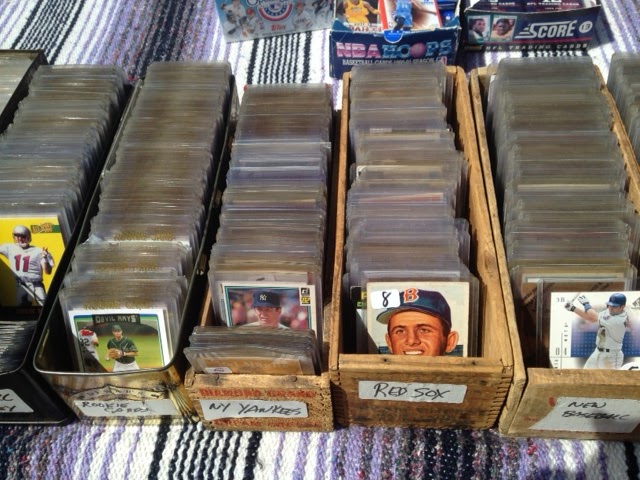

The beaches and bike trains and Ben and Bills ice cream are all great, but my favorite moment of each year's journey may be the first few minutes Jason and I spend rifling through the baseball cards at the Chillmark Flea Market. They are split up into beat-up boxes marked "1950-60s" "1970s-80s" and "Red Sox." and we fly through them all -- putting aside those "possibles" we will consider for purchase. 

Little stickers in the top right corner of each card's protective plastic sleeve tell us what it will set us back, and Jason knows I'm seldom going to spend more than $5 for any given card. It's not Honus Wagner I'm after here, but a few moments of my childhood -- and Jason's. 

Before my eyes, my son has quickly become a full-fledged teenager. He grew about 8 inches in the last 8 months, and his voice dropped from tenor to bass. His body is filling out, taking him from the "before" photo in the old Charles Atlas ad much closer to the "after." He recovered from major leg and hip surgery in February faster than anyone expected, and spoke in front of 1,500 students and family members as his middle-school salutatorian in June.

Jason, before time took over.

In two weeks he will be a freshman at Newton North High, my alma mater, and plans to join the wrestling team and the theater program. Other than the three or four games we go to together at Fenway each year, baseball is very far from his mind. I've tried rekindling his interest, but he'd rather talk about movies, music, or even politics than the Red Sox pitching rotation. I'm slowly accepting it.

For those couple minutes at the flea market, however, both of us are 8 year-olds enthusiastically mining for gold. Ken Goldberg, who owns the cards along with a treasure-trove of road signs, books, and other items, stands back and watches. I am sure he has seen this countless times before -- fathers, sons, and the occasional mom and daughter thumbing back through the decades.

I collected baseball cards feverishly through my grade-school days, picking up most of them at Garbs drugstore by the Boston College trolley stop. Friends -- Greg Rutan and Kim Myers most spring to mind -- would accompany me on these trips, and we'd look over our loot while devouring ice cream sundaes next door at Brigham's. We'd always hope for Red Sox, of course, and barring that a star like Munson or Palmer or Foster. 

Ken helps bring me back.

It was the same with me and Jason when he was a little kid. We'd haunt the few remaining baseball card stores left in the Metro West area, and split our time buying new packs and looking through oldies. He devoured baseball history books and covered his walls with posters of Big Papi, Ted Williams, Hank Greenberg, and (of course) Jason Varitek.

Then, one by one, the stores starting closing, reflecting a generation of kids that was moving increasingly online or onto "faster" sports like basketball and football. My son's interest waned along with the public's; he was a mediocre ballplayer, like his old man, and probably stayed in Little League one year longer than he wanted to for my sake.

Now Jason is a self-professed nerd who spends his time writing and playing intricate online computer games with friends all over the world. The posters and books in his room are changing along with his interests. My nephew is the baseball star; Jason is the star of Katan. 

Until we get in front of Ken's table.

"Look -- a '75 Yaz!" Jason yells, at the same moment I pull out my 1960 Nelson Chittum (I'm a sucker for any card with that old smiling Red Sock logo). A confident-looking 1978 Bill Lee -- that summer, I remind Jason, would not turn out well for him or the team -- comes out next. 

He spots a '65 Tony Conigliaro, where the 20-year-old stares out at the camera with a steely resolve. The card is bent and faded, giving it no real value, but Jason knows better: this is Tony C. in all his young, handsome glory, before the Gods of Fate beat him down.

Forever young.


Tuesday, June 2, 2015

Red Sox Bobbleheads we'd like to see -- 2015 team & retro set

In honor of Mike Napoli Bobblehead Night, here are some other Red Sox past and present we'd like to see similarly honored -- with a bit of revisionist history at work:

Eduardo Rodriguez following through during record 9th straight win to start his MLB career. 

Pablo Sandoval completing a RIGHT-HANDED home-run swing.
(just reverse the picture--I can't find one)

Hanley Ramirez making leaping catch against the Green Monster -- the ball snug in his glove.

Nine mini-Brock Holts manning all nine spots on the diamond.


Jon Lester shaking David Ross' hand after hurling an 8-0 shutout on Opening Day, 2015.

Nomar Garciaparra going through his between-pitch rituals.

Carl Everett petting Wally the Green Stegosaurus.

Wade Boggs pissing off Barney by drinking all the beer in Moe's Tavern.

Bill Buckner singling to finish Boston's 4-run, game-winning rally in 9th inning of Game 7 of 1986 World Series at Shea Stadium.

Carlton Fisk signing his new three-year contract after it arrives in the mail on Dec. 18, 1980.
It's a 1981 card (sigh)

Don Zimmer and Bill Lee hugging after Lee shuts down the Yankees to save the 1978 AL Playoff.
(This was taken a few innings before)

Bernie Carbo rounding the bases  after his third pinch-homer of the 1975 World Series clinches the championship for Boston.

Jackie Robinson, resplendent in his home white Red Sox uniform, congratulated by on-deck hitter Roy Campanella after Opening Day homer, 1949.
(I know, just squint and make believe)

Babe Ruth on deck in 1927 World Series for Red Sox at Fenway Park -- Boston's fifth Fall Classic of the decade in "The House That Ruth Shook."


Saturday, June 7, 2014

How I learned to love Don Zimmer (even in pinstripes)

Zim, how his players knew him. (Getty Images)

As children our thoughts and actions are largely influenced by the adults around us. For kids who grew up in New England during the late 1970s, Don Zimmer never really had a chance.

Everywhere we turned, the manager of the Red Sox was getting bashed as an incompetent boob. If we went to Fenway Park, we heard Zimmer booed from the moment he stuck his head out of the dugout. In April of '79 he even got booed at Fenway on Opening Day, an honor usually reserved for politicians -- not guys who led their team to 99 wins the year before. 

When we listened to The Sunday Night Sports Huddle on WHDH radio, a rite of passage into mature fandom, we heard Zimmer maligned each week by Eddie Andelman and his co-hosts for failing to make the playoffs with the likes of Fisk, Lynn, Rice, Yaz, and Dewey in his lineup. Callers who mentioned the manager's real name were immediately cut off; "Chiang Kai-shek" was how you had to identify the Boston skipper on The Huddle, and even if we didn't know who that was, we laughed right along with Eddie, Mark, and Jim.

Full Popeye mode. (Boston Red Sox)

Zimmer looked like a cross between two cartoon characters. His long, muscle-bulging forearms, pudgy, tobacco-filled cheeks, and squinty eyes made him a ringer for Popeye the Sailor Man, while his short, stout torso and legs were more a match for Popeye's hamburger-eating pal, Wimpy. Throw in the regrettable softball-style, V-necked tight nylon uniforms the Sox wore during this era, and it wasn't a pretty picture. 

This guy was a sports cartoonist's dream, and since the Boston Globe had one of the best in Larry Johnson we were treated to a steady diet of hilarious images. One of these adorned the office door of my summer camp's  head baseball coach for years, a yellowing reminder of just how silly Zimmer appeared to the world.

For us easily impressionable preteens, the member of the Sox to emulate was lefty pitcher Bill Lee, California cool with his long hair, sharp wit, and funny nickname of "The Spaceman." Zimmer was known around the game, logically, as Popeye, but Lee gave him the moniker most often used by kids and hecklers to describe the manager: "Gerbil." 

The anti-Zimmer brigade was often loudest at home, where my stepfather hurled a barrage of insults at the Zenith that he fully expected the skipper to hear. These reached a fever pitch in the summer of '78, when the Red Sox blew a 14-game lead in the AL East and the Yankees roared back to win a one-game playoff at Fenway behind Goose Gossage, Reggie 
Jackson, and Bucky "Bleeping" Dent. Today a 99-63 record almost surely gets a team into the playoffs as a Wild Card; back then all it got you was second place and a plane ticket home.
Zimmer in '78 -- when it all slipped away. (Topps)

Late in the 1980 season, with the injury-plagued Red Sox limping toward a fourth-place finish, Zimmer was fired. Grandfatherly Ralph Houk took his place, and while the Sox still didn't win anything, the manager-bashing and booing largely stopped. The human punching bag had left town. 

Then something happened. As I passed through into high school and college, and learned more about Zimmer's background and reputation around the game, my feelings started to change.  

The roly-poly guy who waddled like a Weeble on his trips to the mound had once been a nimble shortstop who stole 60 bases (including 10 thefts of home) his second year in pro ball. Zimmer was one of the best power hitters in the minors and on the fast track to make the venerable Brooklyn Dodgers before he was beaned in a 1953 game and suffered a fractured skull.

For two weeks Zimmer lay in a coma, and doctors had to drill holes in the sides of his head to relieve pressure on his brain. Against all odds he not only returned to baseball, he made the major leagues with the Dodgers a year later. (True to his '70s image, the only fact we knew about this scary incident as kids was that "blockhead" Zimmer had a steel plate in his head.)

He never achieved stardom with the Reese-Robinson-Snider-Campanella Dodgers, but was a valuable role player who had 15 home runs in 88 games at second, short, and third in 1955 to help Brooklyn to its only World Series title. He survived another serious beaning that cost him much of the '56 season, and won a second World Series with the Dodgers in '59 after their move to Los Angeles.
Zim, young and a Dodger. (CNN/SI)

Statistics don't always tell the whole story about a player, and they certainly did not with Zimmer. He hit just .235 with 91 homers over 12 major-league seasons, and upon being traded from the Dodgers suffered in purgatory with dismal clubs like the 1962 Mets and 1963-65 Senators. He lasted as long as he did because he was tough, played hard, and was very well-liked by his teammates. Versatility was another plus; he suited up at every position but first base and center field in the majors, and even caught 35 games with Washington.

After his playing days, Zimmer never left the game. He coached in Montreal, managed the talent-poor Padres in their early years (a job from which he resigned and was not fired, as he'd prove with a letter he carried in his wallet), and came to Boston as a coach under Darrell Johnson. Look closely at the reverie after Carlton Fisk's famous 1975 World Series home run, and you'll see Zim (coaching third) is the first person to congratulate Pudge as he heads to home plate.  

Speaking of home plate, Zimmer was married there -- honest. He wed his beloved Jean (nicknamed "Soot") at the dish before a minor league game in '51, and was still with her when he died. 
Wedding bells -- and bats 

Zimmer's post-Boston journey included a decent managerial stint with the Rangers and a fantastic job at the helm of the 1989 Cubs, capturing an NL East division title and Manager of the Year honors. Amazingly, he even came back to the scene of the crime -- coaching with the awful early 1990s Red Sox under his former Boston third baseman, Butch Hobson. That took guts, and perhaps knowing it, fans gave Zimmer a break from the booing (turning instead on Hobson).

Ironically, the revival of the Yankees-Red Sox rivalry occurred with Zimmer in the opposing dugout as bench coach and consigliere to manager Joe Torre on the four-time World Series champion Yanks of 1996-2003. As Bostonians we hated the Yankees, but it was now impossible to hate Zimmer. Leaning over to whisper to Torre, or breaking into a grin and whacking Derek Jeter on the back after a good play, he looked more like a grandfatherly fan than a guy drawing a paycheck from Steinbrenner.


Zim and Torre (Torrie Keith, Daily News)

Then there was the moment when Zimmer, angered at Red Sox ace Pedro Martinez for throwing at Karim Garcia's head during the 2003 ALCS, charged across the Fenway diamond to go after the pitcher. A shocked Martinez pushed the 72-year-old coach to the ground, an act which while not malicious in intent left a bad impression on all who saw it. When Zim apologized during a press conference the next day, tearing up in the process, he was the furthest thing from a gerbil. He was more like a teddy bear.

Perhaps appropriately, Zimmer left the Yankees after that season, which meant he wasn't on The Dark Side when the Sox finally broke through in October 2004. He returned to his Florida home and took on various advisory roles with the Rays, changing his uniform number each spring to reflect his years in the pro game. This season it was 66.
The last of many uniforms.

Three titles in ten years mellowed Boston fans, and Zim claimed he always enjoyed coming back to Boston. We learned he had been listening to the talk shows all those years ago, and it had eaten him up, but that he felt fans had the right to boo him if they wanted. He even rented a house from Bucky Dent one year -- and loved to tell the story of how photos depicting Dent's '78 home run at Fenway hung in every room.

Hearing of his death, I felt like I had lost an old friend -- even though I never got closer to Zimmer than across a crowded room. The tributes came from every corner of the hardball universe. 

"I never met anyone was more pure baseball than Don Zimmer," Boston Globe columnist Bob Ryan wrote in a tribute. 

"He was, without a doubt, one of the most beloved players on the team," said Vin Scully, Dodgers broadcaster from Zim's days with the club until today. That says a lot, when you think about the guys on that Brooklyn/Los Angeles team.

Sure, he should have rested Fisk more in '78 and taken out Hobson when he had bone chips floating in his elbow. He should have pitched Lee against the Yanks in September (or in the playoff game), but while this may have driven the fans and talk show hosts nuts, his players on the Sox loved him. 

Sorry for the boos, Zim. We were just kids. We didn't know better.

Rest in Peace, Don. (Topps)


Wednesday, October 23, 2013

Fenway first-pitch-and-catch honorees it would be fun to see

The mayor belongs on the mound.

Everybody from Peter Gammons to John Farrell's housekeeper has dissected the Red Sox-Cardinals World Series match-up position by position, so at Fenway Reflections we thought we'd focus on another important aspect of any postseason contest -- the first-pitch throwers.

Sox VP Dr. Charles Steinberg and his crew have always done a great job trotting out honorees for this task, including 2004 heroes Dave Roberts and Bill Mueller during the last two ALCS games at Fenway Park. Tonight it's Hall of Famer and recent statue recipient Carl Yastrzemski handling the chore for Game 1, and it's hard to argue with that choice.

But if we could put pomp and circumstance aside, along with superstitions about past Series lost, wouldn't it be great to see some of these folks stride out to the mound and back behind the plate?


Dick Hoyt to Rick Hoyt

The Hoyts on the hills.

Well known to any true fan of the Boston Marathon, this father-son racing duo has inspired millions through the years. Who hasn't teared up watching Dick push Rick's custom-made wheelchair up Heartbreak Hill or across the finish line? When you learn the story behind their partnership, especially the accomplishments Rick has achieved off the course, your respect can only grow. These guys live "Boston Strong" every day.


Billy Rohr to Russ Gibson 

Not worth much, unless you know the story.

Gentleman Jim Lonborg was the big winner on the 1967 Red Sox, and the Cy Young Award winner has been justly honored as a first-pitch tosser on several occasions including Game Two of this year's ALDS. It was rookie right-hander Rohr, however, who first signaled to New Englanders that the '67 Sox might be worth watching when he came within one pitch of a no-hitter at Yankee Stadium in his very first major league game. Gibson, his catcher, was also making his big-league debut that day. That's the kind of stuff Impossible Dreams like 1967 -- and 2013 -- are made of.


Oil Can Boyd / Bob Stanley to Rich Gedman

Gedman tags out Gary Carter in the '86 Series.

Bill Buckner has gotten his moment of first-pitch redemption at Fenway -- actually, several of them, including Opening Day in 2008 before the '07 champions got their rings. He has received his standing ovations, and now it's time for three more members of the near-miss 1986 Red Sox to get theirs. 

Boyd, Stanley, and Gedman were all one strike away from World Series rings, and deserve some love to replace the angst they experienced during the meltdown at Shea Stadium. Stanley and Gedman are both New England natives who became All-Stars for the team they rooted for as kids, and the charismatic Boyd has settled down to make his home here. The Red Sox would not have won the '86 AL pennant without them, and now it's time to let them know they are appreciated. 

Jordan Leandre to Mike Andrews 
Leandre to Andrews would be a beautiful battery.

Leandre first gained Fenway fame as a 4-year-old cancer patient, singing the National Anthem before several games in the magic summer of 2004 and the next few years thereafter. Fans watched him progress from two full-leg casts to a wheelchair to a limp and then a triumphant run around the bases. He's since graduated from the Jimmy Fund Clinic to a healthy career as a teenage pitcher, including a no-hitter in summer-league play.

Andrews, a rookie Red Sox second baseman on the 1967 AL champions, devoted more than 30 years to fighting pediatric and adult cancer as chairman of the Jimmy Fund, and still looks like he could turn a double play at age 70. He's famously shunned the spotlight in the past, but honoring him would be a natural choice in this, the 60th anniversary of the Jimmy Fund-Red Sox partnership 

Bill Lee to Carlton Fisk 
A near-miss battery.

This battery started Game 7 of the 1975 World Series vs. the Reds at Fenway. Left-hander Lee was one botched double-play and one eephus pitch away from a championship toast at his beloved Elliot Lounge, while Fisk -- who had famously won Game 6 with his homer off the left-field foul pole -- just missed a title in his only Fall Classic of a 24-year catcher career. Polar opposites off the field, the stoic Fisk and iconoclastic were in perfect harmony on it.


Thomas Menino to Bill Russell

Russ knows rings.

Sure, he often gets poked fun at for his creative use of the English language, and he sometimes gets his sports facts wrong, but Menino has done much right for Boston during a record five terms as the city's mayor. As he readies to retire from office, this would be a great way to honor the man who stood Boston Proud after the Marathon bombings and many, many other times. 

Celtics great Russell is the greatest champion in Boston sports history and will be getting a statue in his honor here on Nov. 1 thanks in large part to Menino's lobbying. We know Russ doesn't have much of a throwing arm from watching a previous first toss, but it would be fun to see him crouch down for Menino's delivery.


Terry Francona to Jason Varitek 
Two of the great minds behind '04 and '07. 

Yeah, things ended badly for Tito here, but what better way to bury the hatchet? He received a nice Fenway greeting during his return with Cleveland this summer, but an appearance here would bring down the house.

Saturday, September 29, 2012

Oil Can opens up about 1986, Bobby V., drugs, and how he REALLY got his nickname


Before Clemens, Oil Can was Boston's ace

It’s been 20 years since Dennis “Oil Can” Boyd pitched in the big leagues, but he can still bring some heat when it comes to conversation.

I met up with Boyd for a book signing at New England Mobile Book Fair in Newton, Mass., last weekend, and then stayed after for a few hours to talk with one of my all-time favorite Red Sox pitchers. His book, They Call Me Oil Can (written with Mike Shalin) is a no-holds-barred, colorful look at his career and life, and he's just as open – and outspoken – in person as in print.

From our chat, here are the Can’s reflections on…

How he got his nickname: “Everybody says it's because I drank a lot of beer and they called beer “oil” down in Mississippi, but that's not true. It was rot-gut whiskey. Everybody in Meridian, where I grew up, drank it. You got it from a lady up the street named Big Mama, who was the neighborhood moonshiner. I used to go up to her house and fetch it for my mother, sneaking it into our house under my shirt so my father wouldn't see it.

“When I was 7, I started drinking some myself. One day somebody caught us in a tin shed drinking Big Mama's whiskey out of oil cans, so my friend Pap started calling me “Oil Can.” I wrote it under the bill of my baseball cap, and my high school teammates started calling me that too. It stuck.”

Bobby Valentine: “I played for Bobby in Texas, and he’s a good guy. He’s open and will talk straight to you. He could be temperamental, sure, but he’s a very, very smart baseball man. He knows games and respects players, but he’s the skipper. Ballplayers should'n’t be telling him what to do. Your job as a player is to hit the ball or catch the ball; he manages and you play. When you make up all kinds of distractions, this is what happens – the team can’t win. They got the talent, but they never listened to the man.”

Wade Boggs (who Boyd claims often directed racial slurs at him when they were teammates): “He’s a bigot; it’s ingrained in his family history. Coming from Central Florida, that’s just what you grow up hearing and learning. He was protected by baseball then, and nobody will say anything against him now. The Red Sox don’t invite me to anything that Wade is going to be at because they know I’ll kick his ass. He wasn’t at the 100th anniversary celebration, right? I was – so there you go.”
For much of 1986, The Can was The Man.

The summer of 1986 (when he was suspended for 21 games after briefly quitting the team following an All-Star snub, but still went 16-10 to help the Red Sox win the pennant): “Being a young ballplayer, with money in your pocket, makes you very vulnerable. There were a lot of distractions and a lot of ways to get into trouble. I found them. It was my fault, sure, but I felt there was nobody I could talk to about it. Still, people looked out for me; I lived in Chelsea, and sometimes I'd be out late at night and the police would come and say, “C'mon, Oil Can, you don't want to be messing around here, you can get shot or killed,” and they would give me an escort home.

“While I was suspended I hurt my arm in a tussle with some cops; they thought I was getting drugs from a guy and really roughed me up good. I would ice my arm every day, but it always hurt. I could hear a clicking in it. But still I kept pitOil Caching, winning the [AL East] clincher against the Blue Jays and through the playoffs and World Series. I didn't tell anybody about the pain.”
During the '86 postseason, Boyd gets his views heard.

On not starting Game 7 of the '86 World Series, when, after a rainout, manager John MacNamara decided to go with Bruce Hurst and skip over Boyd: “When it came time for Game 7, and he [MacNamara] told me I wasn't starting, I didn't know what to say. I just ran off and cried. They used the rain as an excuse, and said Bruce had the hot hand, but I felt that circumstances during the season led to that decision. They put their personal feelings about me ahead of the team. They were not going to take a chance on my going out there and winning the World Series after everything that went on. [Hurst, who had already won twice in the Series, pitched six innings and left with the game tied 3-3. Boston relievers broke down, however, and the Mets won, 8-5. Boyd never got into the contest.]

How he stayed focused on the mound: “I smoked dope – every day. I started when I was 12 and never hid it. I was such a thinker, my mind was never idle, but when I smoked I got locked in. I was so focused, I couldn't hear anything else on the field. I became creative, like an artist doing a painting. A little blue here, a little red there; a curve ball here, a slider there. It got to the point where [first baseman] Billy Buckner would come over and say, “Are you high?” If I wasn't, he'd say “go get him some.”

Boyd was clearly upset as he talked about how things went after '86, when a blood disorder required him to inject a needle with blood thinners into his stomach every day. He was on the disabled list much of the time, and after 1989 signed with the Expos as a free agent. He rebounded to pitch nearly 200 innings each of the next two seasons – often very effectively – but after a trade to Texas and a late-season slump in 1991 was unable to find another big league job at age 31.
The Spaceman (left) and Oil Can trade pointers.

Oil Can felt he had been blackballed, and I realized he had a lot in common with another great free-spirited Red Sox who could pitch and talk up a storm: Bill “Spaceman” Lee. Both men liked their weed, both men were passionate, personable ballplayers embraced by teammates and fans, and both had their careers in Boston end on a down note before a brief resurgence in Montreal. Both felt the baseball establishment kept them from staying on in the majors, and they had two of the greatest – and most famous – nicknames in big league history.

The Can seems at peace with himself these days. After a decade where he said anger over his shortish MLB career forced an estrangement from his wife and two kids, along with a bad cocaine habit, he's quit hard drugs and is back with his family and running the Oil Can Boyd School of Baseball in Providence, Rhode Island.
Two authors hook up at the Mobile Book Fair in Newton. 

He does some private coaching with high school teams as well, along with an occasional event for the Jimmy Fund or other charity. And while he rarely gets to Fenway, he was back for the 100th anniversary celebration in April and got a terrific hand from the crowd when introduced. That meant a lot to him.

“I fight every day not to go out and get drugs, but it's a private fight,” he told me. “I don't call it being clean, I call it being tolerant. I stay healthy, and I'm on a baseball field seven days a week. That's where I feel the most comfortable.”

That's one more thing he and the Spaceman have in common: both are still pitching. Lee has hurled in a variety of leagues through the years, and this summer, at age 65, became the oldest man in history to win a professional game when he went all nine innings for his hometown San Rafael Pacifics of the North American League in a 9-4 victory over Maui.

Boyd, who moved back to New England just in time for the wonderful Red Sox summer of 2004 , now lives in Providence and pitches with teams in two divisions of the Men's Senior Baseball League – one for age 35-and-up, the other for 48-and-up. He's still lean and spry a few weeks short of his 53rd birthday, and says he plays shortstop when not on the mound.

“I gotta go work out, I'm pitching tomorrow,” he told me with a smile as he left the Mobile Book Fair. I thanked him for the time, and all the joy he gave Red Sox fans back in the mid-'80s. It was fun to watch him then, and fun to talk to him now.  

Sunday, August 26, 2012

Red Sox announce “Operation Sellout Streak” incentives


Fenway Fiction

The Red Sox are hoping for less scenes like this in the weeks to come.

In an effort to keep up fan interest and keep alive their record sellout streak, the Red Sox have announced special fan incentives for the remainder of the 2012 season.

Fans who show up at Fenway Park will now get a special thank you from management: tickets to another upcoming home game. “We want to thank the best fans in baseball for their loyalty as we continue to improve our team,” Red Sox president Larry Lucchino said after last night's 10-9 loss to Kansas City. “Let's show everybody how much we care by filling those seats for our final 13 home games.”

“Operation Sellout Streak” will attempt to extend professional sport's longest-ever sellout streak, which currently stands at 780 games but has come under scrutiny in recent weeks due to what appears to be thousands of empty seats at Fenway and the availability of tickets online for as little as 10 cents.

In addition to the free tickets, fans will also have the chance at additional rewards for showing their loyalty. Those who arrive at games before the third inning and stay until the final out will receive “I kept the streak alive” stickers, while those who stay off their cellphones for at least half the contest will get a free “I filled Fenway” poster depicting the ballpark loaded to capacity for a Red Sox-Yankees contest.
Fans will be rewarded for their loyalty.

“We know it has been hard for fans to get through some of these early-inning letdowns, or some of the late-inning meltdowns,” said Lucchino after Boston blew a six-run lead for the second time in a week. “Better days are on the way, but until then we hope Red Sox Nation will keep with us and keep the faith.”

As yet another incentive to keep fans coming, the Red Sox announced that a “mystery pitcher” will start one of this year's remaining home games. Bill Lee, who at age 65 became the oldest pitcher ever to win a professional game for the San Rafael Pacifics in the North American League last week, is rumored to be one of the candidates.
Bill Lee: starting soon at Fenway?