Showing posts with label luis tiant. Show all posts

Friday, September 20, 2019

In lost season, Red Sox found a new ace: Eduardo Rodriguez

Seen often this season: E-Rod gets a hand (AP)
Earlier this summer, Eduardo Rodriguez was asked what he attributed to his rapidly rising star on the Red Sox pitching staff. In slow but thoughtful English, which has improved along with his game, the Venezuelan left-hander said that rather than trying to emulate the three Cy Young Award winners who preceded him in Boston's starting rotation, he was now focusing more on himself -- on being the best he could be as a pitcher.

E-Rod's insights, which seemed astute at the time, have grown increasingly sagelike as this hugely disappointing Red Sox season has continued.

Those three Cy Young winners who helped Boston to the 2018 World Series title -- Chris Sale, David Price, and Rick Procello -- have all fizzled due to injuries and ineffectiveness. Rodriguez, meanwhile, has quietly put up the kind of numbers that traditional fans and the analytics crowd can all appreciate.

If you still believe that victories by a starting pitcher have relevance, E-Rod is your man. His 18-6 record after yesterday's victory over the Giants would look just as impressive in 1990 as it does today, and with two starts left he still has a shot at 20 wins -- a magic figure that has largely gone the way of the dodo and $1.50 bleacher seats.

His Twitter feed says it all: E-Rod is PUMPED!

Rodriguez is no Jake deGrom when it comes to ERA, but his 3.53 mark was good for 7th in the American League entering tonight despite the hardship of being a lefty who calls Fenway Park home. He has kept his team in games all season, and the Red Sox are 24-8 in his 32 starts. In games started by anybody else, they are 56-64.

Some people cite Rodriguez's tremendous run support in downplaying his success. For much of the season, Boston scored more often with E-Rod on the mound than any other MLB pitcher. But that is certainly not his fault; in fact, it's a trend any pitcher would covet. The aim of the game is to score the most runs and win. When Rodriguez pitches, the Red Sox usually do both.

Even more impressive is this: During the long, slow march to the end of Boston's championship reign, as his rotation-mates have floundered and flamed out, Rodriguez has shone brighter. He is 10-2 in his last 15 starts, with a 2.21 ERA and 6.2 WAR -- marks that would earn him heavy Cy Young consideration of his own were he to continue them over a full campaign. He's got something to prove, and it shows.

No one is going to confuse Rodriguez with Sale when it comes to strikeouts, but not trying to mow everybody down seems to agree with E-Rod too. He's no slouch in the department -- with 199, he ranks 9th in the AL -- but given the choice between heat and control, he seems content on the latter. Pitching to contact means quicker outs, which is keeping him in games longer.

Home and away, Rodriguez has caught on.

This might be the single most important change in Rodriquez circa 2019. Last year, when he went a solid 13-5 with a 3.82 ERA, E-Rod was known as a six-inning pitcher. This season he has gone 7+ innings eight times, and is 6th in the league in innings pitched. The decision to limit the workload for Ming vase mates Sale and Price in spring training backfired, in that both pitchers failed to last deep into the season before getting injured; E-Rod, in contrast, has been E-Long in August and September.

If Sale and Price were doing the same, even with the team's horrendous April, Boston would likely be pushing for the playoffs the final week of the regular season -- rather than playing out the string.

No less an authority than Red Sox pitching legend Luis Tiant cites this as the key to Rodriguez's rise: manager Alex Cora is giving him the chance to pitch out of more tough situations, and E-Rod is gaining confidence in himself. "If you don't give somebody the chance to get out of a jam now," asks Tiant, "when will he ever learn?"

The secret is out: E-Rod is for real. (LaVida Baseball)

Rodriguez is learning now, and along with everything else, he has age on his side.

Modern baseball is a sport where being 30 years old earns you a warning label come contract time, and Boston has three graybeards in Price (34), Sale (30), and Porcello (30). Rodriguez, in contrast, is just 26, an age that throughout the game's history has usually coincided with the start of a player's physical and statistical prime. In other words, while the "Big Three" of Boston's 2018 champs are trying to regain their standing as dependable hurlers come 2020, Rodriguez should be getting stronger and better.

As Boston fans count down the final days of a forgettable campaign -- and cheer for E-Rod to reach 20 wins, 200 strikeouts, and 200 innings -- that's a thought they can hang their Hot Stove hats on.

E-Rod is after it (Barry Chin/Boston Globe)


Saturday, August 3, 2019

As Yankee Stadium weeped, teary Luis Tiant stood tall

On this night in 1979, Tiant took the hill.

Luis Tiant was always known as a big-game pitcher with the Red Sox, right up until his last must-win shutout on the final day of the '78 season. He didn't get to throw as many do-or-die contests with the Yankees, but 40 years ago today, on August 3, 1979, a heartbroken El Tiante shined throughout what he later called "the toughest game of my life."

The previous day, just after the Yankees returned from a road trip, shocking news quickly spread across the sports world: New York catcher and captain Thurman Munson had been killed at Akron-Canton Regional Airport while practicing takeoffs and landings in his private jet  He was 32 and left a wife and three young children.


In just half a season with the Yankees, Tiant had already grown close with Munson, the team's tough-as-nails leader. Maybe it's because Luis spent parts of the previous eight years throwing to the only receiver in the American League considered Munson's peer at the position -- Carlton Fisk -- and was used to working with a strong personality behind the plate. All business on the mound, Tiant loved his new catcher's win-at-all-costs attitude.

Fisk and Munson were heated rivals said to hate each other. Tiant doesn't buy it.

"They didn't hate each other -- they respected each other, and they were competitive with one another because each wanted to be number one," Tiant recalls today. "When their teams met up, they talked often about catching and how hurt they always were."

Fisk and Munson mix it up.

One fact, forgotten to time, seems to support Tiant's view. Munson's widow, Diana, later said that only one non-Yankee player sent a personal note to her home in the days after his death: Carlton Fisk.

When it came to New York's August 3 home game against the first-place Baltimore Orioles, nobody would have questioned it if the Yankees canceled or postponed the contest. But Diana said that her husband would have wanted his teammates to play, and so they did -- with a weary lineup still in shock. Some veterans were too broken-up to take the field, but manager Billy Martin didn't have to worry about his starting pitcher.

A moment of silence for their captain. 

It was Luis Tiant's turn in the rotation, and even at nearly 39 years old, El Tiante never said no to a challenge.

In Boston, his bravado and brilliance went hand-in-hand. He had long been The Man, the undisputed ace of the staff. On the Yankees, however, that role was held by rail-thin, flame-throwing Ron Guidry, with 20-game winner Tommy John #2 behind him. Tiant, as sage a hurler as the game had ever known, was no longer a top gun, but he was still capable of great performances.

Initially, he did not think this was going to be one of those nights.

"There was a service before the game," he remembers. "Every starter stood out at his position except catcher Jerry Narron; the spot behind the plate was left empty until the game started. There were some prayers, someone sang "American the Beautiful," and when they put Thurman's picture up on the big scoreboard...WOW. I was crying on the mound, and the fans stood and cheered for nearly ten minutes. At one point they all started chanting Thurman's name, and I felt like they were never going to stop.

The Stadium rocked as Munson's image glowed.

"Then I had to pitch!"

He says he's not sure how he got through the game, but wound up going eight innings and giving up just two hits. One, a home run by John Lowenstein in the second inning, wound up the only run of the contest. Scott McGreggor, with ninth-inning help from Tippy Martinez, got the win for the Orioles. He was a very close friend of Munson's and cried throughout the game.

"I wanted to win for Thurman so bad," Tiant says today, "but that's the thing about baseball. Even when you should win, sometimes you don't. But God gives you the strength to keep fighting."

Forty years later, fans and players still remember that game -- and how Luis Tiant showed great heart while hearts around him were breaking.

Is it any wonder why Tiant remains one of the few men to play for the Red Sox and Yankees to be universally loved in Boston and the Bronx?

Luis Tiant quotes from Son of Havana: A baseball journey from Cuba to the big leagues and back


Thursday, May 12, 2016

David Price chases history and the Ghost of Earl Wilson

Price's start has baffled the experts. (AP)

When he takes the mound tonight at Fenway Park,  David Price will be doing more than trying to turn around his season.

There is a fact that you won't find mentioned in his long Red Sox media guide entry, or anywhere else. In many respects that's a good thing -- a sign of progress. Even he likely doesn't know about it,

As history, however, it is worth acknowledging.

When the Red Sox signed Price to a seven-year, $217-million contract last December, they did more than make him the highest-paid pitcher in MLB history. The move meant that, barring injury, the team's No. 1 starter entering the 2016 season would be African-American -- a first for a franchise that dates to 1901.

The Price was right in December. (AP)

Even at a position where there has traditionally not been a tremendous amount of racial diversity at the MLB level, this is surprising for such a storied organization. And while it can't be linked entirely to the team's dubious racial past, this does play a part.

There have, of course, been men of color atop the Boston rotation. Pedro Martinez is the best pitcher most of us will ever see, and the pride of the Dominican Republic. Luis Tiant, the big-game king of the 1975 American League champions, was as famous for his long exile from Castro's Cuba as for his topsy-turvy delivery and victory cigars. Both Pedro and El Tiante were beloved, charismatic winners, but neither was African-American.

Oil Can Boyd, the Mississippi-bred son of a Negro League player, went 15-13 with 3 shutouts for a mediocre Boston club in 1985. He seemed on the verge of No. 1 status, until Roger Clemens' rapid ascent in '86, coupled with Boyd's injuries and off-field problems, kept him from achieving it.

Boyd claims racism was also a factor. This can't be proven, but the other pitcher with perhaps the most legitimate chance to be Boston's first African-American ace was undeniably denied that shot by one of the ugliest injustices in team history -- which happened 50 years ago.

Earl Wilson was called up to the Red Sox in 1959, just a few weeks after infielder Pumpsie Green's promotion made Boston the last of the sixteen original MLB clubs to break the color line. During the next several seasons, the right-hander established himself as a very good pitcher on a very bad team. Twenty-game winner Bill Monbouquette was undeniably Boston's ace, but Wilson was a rising star who pitched a 1962 no-hitter at Fenway Park in which he also homered.

Wilson's no-hitter earned him a $1,000 bonus. (AP)

A down year by Monbouquette prompted his trade after the 1965 season, opening the door for Wilson to step into the No. 1 role. He had poise, experience, and confidence -- all the makings of a star.

Then came spring training of '66, which the Red Sox spent in the still-segregated Deep South. Wilson stepped into the Cloud Nine bar one hot night in Lakeland, Florida, with white teammates Dennis Bennett and Dave Morehead.

After taking drink orders from Bennett and Morehead, the bartender reportedly looked at Wilson and said, "We don't serve niggers here."

A Louisiana native, Wilson was not surprised -- but still angry. He went to team management, and was told to forget about the incident. He later said he thought long and hard about doing just that, knowing the club's dubious reputation in racial matters. In the end, however, he felt he could not remain silent and went to the press.

Even a great power stroke couldn't save Earl.

A few stories appeared in the newspapers, and the front office failed to condemn the incident or back its ballplayer. From that point on, it was only a matter of time.

On June 17, despite a fine 3.84 ERA for a last-place club, Wilson was traded to the Detroit Tigers in a terrible one-sided deal involving otherwise nondescript players. By stirring the pot, Wilson and others close to the situation believed, he had sealed his fate.

It can be argued that Wilson had the last word. He won a combined 18 games (mostly for Detroit) that summer, and then upped his record to 22-11 for the Tigers in 1967. The '68 season ended with a World Series championship, and Wilson -- still a stalwart in the Detroit starting rotation -- was celebrated as a key man in the title run.

Wilson won big in Detroit.

He settled in Michigan and went on to a successful business career after baseball, but the pain of what happened to him in Boston remained with Wilson until his 2005 death. The sting of injustice, and of being left out to dry by an organization to which he had given so much, was "the most humiliating experience of my life."

Now the Red Sox are one of the most racially diverse teams in baseball, and David Price has a chance to avenge this proud, personable man and knock down the final racial wall of Boston baseball. Price may never have heard of Earl Wilson and the Cloud Nine bar, but it's one more reason to root for the would-be ace.

Price ponders -- and hopes for better days.

Wednesday, October 21, 2015

The 1975 Red Sox helped save baseball -- and my childhood


Forty years ago tonight the Red Sox and Reds played what is routinely cited as one of the greatest games in sports history. Filled with high drama and compelling characters, Game 6 of the 1975 World Series set TV viewership records and jump-started baseball's popularity -- which had waned with the rise of the NFL and Monday Night Football.

Some say Game 6 saved the National Pastime. It definitely helped save me.

I was in the stands at Fenway that cold October evening, and wish I remembered it better. It was well past an 8-year-old's bedtime, and most of my recollections of the evening revolve around the pregame -- when I joined the multitudes shouting "Looie! Looie!" into cardboard megaphones as we watched ace Luis Tiant warm up in the Boston bullpen -- and the climax -- lots of screaming, hugging, and organ playing after Carlton Fisk's shot to left field banged off the foul pole for a game-winning homer.


The 7-6 Red Sox win only temporarily staved off a Cincinnati celebration the next night in Game 7 , but the feats of Pudge, El Tiante, and their teammates during that season and beyond had a lasting impact on me -- providing a way to survive and then escape from the darkest force of my childhood.

Before '75, the Red Sox were not on my radar screen. My big brother Adam played in the Newton Central Little League, and I went to his games, but my father was an MIT-educated engineer who liked to joke that he "wasn't created with a sports gene." Dad could build or fix anything but looked like Felix Unger when throwing a ball.  

Baseball was never on the radio or the TV, and I connected with my father by building plastic model cars in his basement workshop. I'm not sure I even knew who Carlton Fisk was then, but I could tell any two Ford Thunderbirds apart by studying the taillights of my AMI replicas. At the time that was good enough.


Pre-Sox stats: A full-length taillight on the '66.

Then, on Friday the 13th of January, 1975, my parents sat me and Adam down on his bed to tell us they were splitting up after 13 years of marriage. My mother claims I said something mature like "Well, if you don't get along well together, at least this way you can stay friends," but at age 7 I certainly couldn't grasp the seriousness of what was going on. 

Dad moved the next day from our house in leafy Newton to an apartment abutting Routh 95 in Burlington, where the three of us hanged out every weekend watching late-night TV and eating burgers and creamed corn. Adam and I slept head-to-toe on a living room couch, like Richie's big brother Chuck and his college roommates on "Happy Days." 

For Adam, then nearly 11, it must have been scary and sad to see our father starting his life over. For me it felt like an adventure.


Beacon Village: Fun far from Fenway.

We didn't listen or watch baseball at "dad's house," but by the time the Red Sox clinched the American League East that September the games started appearing on the big Zenith in our den. Mom had a boyfriend, and he had plenty of sports genes.

Jack was big and strong, a jock-turned-lawyer and a rabid Sox fan. He had the games on no matter what he was doing; he even had a huge set of headphones with a built-in radio that he wore while mowing the lawn. I still made Rydell models in the shop, but Jack never went down there. To connect with the new man in the house, I had to watch the games too.

So I did -- and got hooked.

While my own baseball skills were and remained mediocre at best, I found I had a natural affinity for understanding the game and its history. Jack, who had played in high school and beyond, explained some of the finer points, and I began listening to the Sox on my clock radio as I fell asleep and then poring through boxscores in the next morning's Globe. Tiant, Fisk, Rice, Lynn, Yastrzemski -- these heroes provided the language I figured would win Jack over. 

"Hey, Looie got the win last night," I'd say to Jack as we passed heading to and from the bathroom, and I'd feel, briefly, like his equal.


When Luis was winning, life was easier.

Dad briefly took over as the baseball man in the family that October, when a friend of a friend hooked him up with tickets to all four home games in the Red Sox-Reds World Series. These were, I believe, my first visits to Fenway Park, but it was not the start of a trend; once the series and season were over we rarely went back.

A clear dichotomy formed in the years that followed. Weekends at dad's house from spring through early fall were fun-filled with mini-bikes and James Bond movies and burgers, while the weekdays back in Newton were for baseball. Dad married his girlfriend Judy, who was and is a great stepmom but also lacks a sports gene. Mom married Jack, assuring that the Red Sox would always be on at her house.


Hoping for the best, fearing the worst.

As I got older and began to understand a little how the real world worked, I learned one had to be careful when watching and listening to games with Jack. 

If the Red Sox were winning, he smiled and laughed and was your buddy; if they were losing the smile disappeared and he filled up his big glass from the liquor cabinet more often. He never took me and Adam to games or even played catch with us -- those honors were reserved for his own son -- so this hit-or-miss bonding was the best I was going to get.

Sprawled out on the shag carpet in front of the TV, with Jack in the dark leather recliner behind me, I prayed for wins. After Bucky Dent in '78 and the dismantling of the club that soon followed, the drunk, angry moods became more common. It wasn't just the slumping Sox, I learned later; Jack's once flourishing law career was also on a downward trend. 


Time for another drink.

It was best just to stay away, and I found I could momentarily forget about him and the scare he put into me by listening to Ken Coleman call the Sox games on WHDH -- "850 on your AM dial." If there was no game on, I could sing along to Jim Croche or Don MacLean albums with my mom. She made sure I felt loved, and when Jack was in one of his dark moods I guess I did the same for her.

By the early '80s, when Yastrzemski was winding down, I had given up any chance of bonding with the big guy across the hall. I still loved baseball, and began taking the Green Line from Boston College to Kenmore Square with friends in a rite of passage that allowed me to escape the tension at home by making a new home at Fenway. Occasionally dad got there with me -- one game he took me and 10 buddies to right after my Bar Mitzvah remains a great memory -- but the Red Sox were mostly "my" thing. That was fine.

Yaz retired in October 1983, but the last links to the '75 team, Dwight Evans and Jim Rice, were still going strong when I left for college a couple years later. The next summer I returned just as the Red Sox and young pitching phenom Roger Clemens were heating up. 

It was the type of club that even Jack and I might have enjoyed together, but by this point Mom had finally endured enough. He was on the way out, and when he meekly offered me great tickets to a few games that August -- not to go with him, just free seats -- I politely refused. I'd rather grab a standing-room spot balanced atop the guardrails behind the last row of Section 25 with my friends than take his weak-ass handouts.


By '86, I'd rather hang here than with him.

I have no idea where Jack is now; the last I heard about him, he had done some time in jail and been disbarred for stealing money from clients. I occasionally Google him but nothing comes up other than a few short stories and court documents describing his incarceration. I know people who know one of his other ex-wives, and a few calls would likely unearth his whereabouts. But I don't make them.

Mom found a guy worthy of her love -- and ours -- and they had a great decade together before he died of cancer. She and dad did indeed stay friendly and still get together with Adam and my families often. Ballgames are usually on in the background; Dad and Judy still have not developed sports genes, but they'll go to their grandkids' games.

Jack is about 80 now; I imagine the next time I read his name -- if I ever do -- will be in an obituary. Forty years after he entered my life, and nearly 30 years after he left it, the fear and anger are long gone. What's left are the memories of a great team, and a love for the game that I developed in 1975 out of desperation -- but has remained far beyond its original intent.

Maybe Jack never took me to Fenway, but now I can go whenever I want. I tend to look at it not as revenge, but it feels sweet just the same. 

Like a fly ball heading deep to left, staying fair, and making us believe anything is possible. 


Saturday, June 14, 2014

Fenway Fun under full moon for Red Sox on Friday the 13th

Nothing could cool off the Sox Friday

The Red Sox have already been dead and buried several times this season, only to be dug up each time they string together a few wins. Those seeking a true turnaround, however, have never been quite as encouraged as last night at Fenway Park.

As I arrived at the damp Fens with almost-10-year-old Rachel (the 2004 talisman), I took all the normal good-luck precautions. I bought a bag of unsalted peanuts from Nick Jacobs' cart at the entrance to Yawkey Way, made sure my lucky cap was on securely, and tapped a Jimmy Fund collection box as I headed to Section 17. We took a shot and settled in about 10 rows in front of our "real" seats, and although I warned Rachel we might get booted, it never happened. 

More positive karma came in the form of the ceremonial first pitch tossed out by Hall of Famer Carlton Fisk. It was Fisk and former batterymate Luis Tiant who did the honors before Game 6 of last fall's World Series, and that night turned out OK. The starting pitcher was the same for Boston as in the Fall Classic finale too -- John Lackey.

This all pointed to a good night for the boys in red (FYI, I prefer the classic white home jerseys), but it was old pal Terry Francona's Indians who struck first. They got to Lackey for a couple runs in the second courtesy of a mammoth home run to right-field from Carlos Santana, which prompted this exchange: 
Santana's dinger quiets the crowd -- for now.
(Associated Press, Charles Krupa)

Dad: "Wow, that was a no-doubter."

Rachel: "Why do they call it a no-doubter?" 

Dad: "Well, there was never any doubt it would go out once it left the bat. But don't worry, it's still early."

Deep done I worried that the offensive doldrums that have haunted the Red Sox all year, especially with men on base, would continue under the foggy full moon. These fears were initially realized when a lumbering Ortiz was thrown out easily at the plate in the bottom of the second after a very poor decision by third-base coach Brian Butterfield to send him with nobody out and Cleveland starter Justin Masterson struggling to find the plate. 

The gaffe was magnified by a couple shots that rolled to the 420-mark in deepest center from A.J. Pierzynski (hitting more than .330 at Fenway!) and Jackie Bradley, Jr. Although they were good for a double and triple respectively that gave Boston the lead, it should have been 4-2 instead of 3-2 -- and with runs so hard to come by lately I worried we'd regret the one squandered. 
Lackey struggled early, finished strong.
(Associated Press, Charles Krupa)

It wound up not being a problem. Although the Indians did things in the third on back-to-back doubles from Asdrubal Cabrera and Michael Brantley, Lackey locked it in after that and would be near perfect until relieved with two out in the seventh. 

Masterson, however, was clearly off his game, and after allowing two walks to start the fourth (his third and fourth free passes of the night) was yanked by Francona. Young lefty Kyle Crockett didn't have much more luck, as a Mike Napoli double made it 5-2. This seemed worthy of a Dad and Daughter selfie, which we promptly placed on Facebook as a cyber-smile to the Reluctant Fan working at home.  

(A sidenote here; while last year Francona was routinely cheered each time he emerged from the Cleveland dugout at Fenway, last night there was almost no attention paid the former Sox skipper and folk hero during his many trips to the mound. I think this is a positive, for although fans here still remember the championships Tito helped bring to New England, this is a new era with new titles and new players -- save Big Papi.)

The middle innings were quiet offensively, but the Sox flashed some fine leather around including a leaping line-drive grab by Brock Holt in left field and a couple diving masterpieces from Dustin Pedroia on ground balls in the hole. It wasn't until later that I learned that Pedroia had gone to the game from the hospital after the birth of his third child earlier in the day.
Dad Petey plays some D.
(Associated Press)

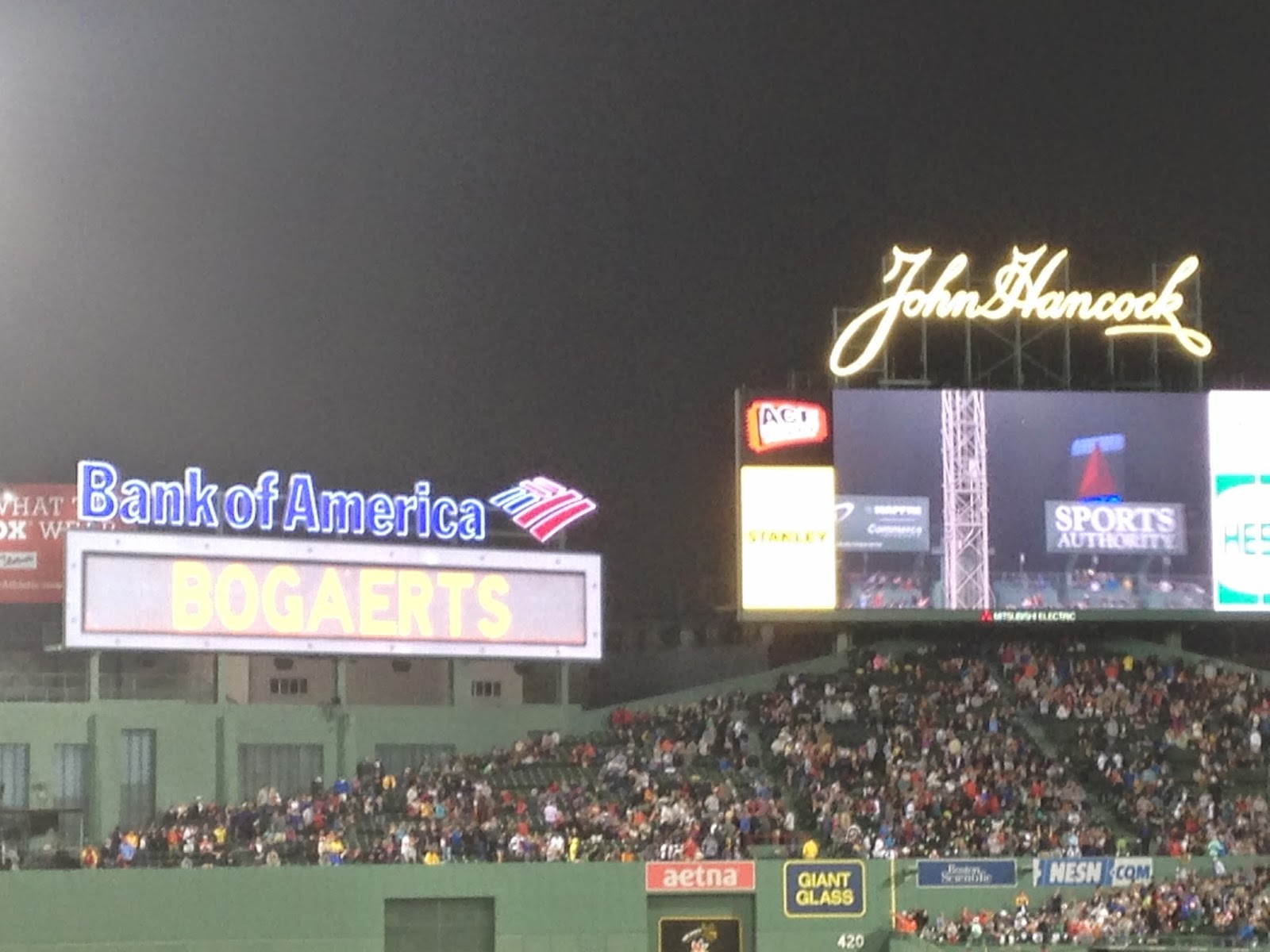
Petey's early Father's Day got a bit happier in the seventh. He was one of nine Sox to bat in a four-run inning, with his double accounting for two of the runs and Napoli (single) and Daniel Nava (double) hits delivering the others. A moon shot off the left-field light tower by Xander Bogearts in the eighth finished the scoring, prompting a gasp from what was left of a rapidly-thinning crowd. 
Xander shakes the lights.

Cleveland was going through the last of its seven pitchers by the bottom of the eighth when Rachel suggested we move down. This seemed like a great idea, so we spent the top of the ninth watching in box seats by the Red Sox dugout as Burke Badenhop struck out the side to end it.

All in a all, it felt like the good old days of 2013. The Red Sox got strong starting pitching, excellent relief work, timely hitting, and contributions from up and down the lineup. Rookies Bogearts, Bradley, and Holt (now hitting .337, and near .400 when leading off) all looked terrific.
That Bradley kid sure can fly.

The winning streak was now at two, and last place comfortably in the rear-view mirror. Is it the start of a bigger turnaround? That remains to be seen, but Rachel and her dad will be back at Fenway Sunday to try to deliver some more good karma.
Rachel's good luck earns her new shades. 
(Note photo bomb by Twins employees)


Thursday, April 17, 2014

Throwback Thursday: In 1976, the Bird was the Word

Two golden boys.

He flashed like a yellow-curled beacon across the baseball sky, a brief blip of innocence and fun before free agency and million-dollar contracts changed the game forever. 

Mark Fidrych. Just saying the name still makes me smile. The Pride of Northborough, Mass., debuted for the Tigers this week in 1976, and died this week in 2009. His sore-armed career in the majors lasted only 58 games, but he's still right up there with Dwight Evans, Luis Tiant, and Pedro Martinez in my pantheon of all-time favorite players.

Maybe it's because I was a rookie too in '76, also playing for the Tigers as a 9-year-old in the Newton Central Little League. I could barely throw the ball straight, but in my genuine woolen uniform -- I think the league phased them out after that spring -- I could stand in front of the mirror and pretend I was The Bird. 

Rookie on the rise.

Forty springs on, I can still recite his rookie stats from memory: 19-9, 2.34 ERA, 250.1 innings, 24 complete games in 29 starts. But numbers only begin to tell the story.

Fidrych, then a wide-eyed 21-year-old with parts of just two seasons in the minors, didn't start his first game for the Tigers until May 15 because manager Ralph Houk wanted to work the youngster in slowly. But The Bird -- named after Big Bird on Sesame Street, of course -- only knew one speed: full-tilt. 

Beginning with a two-hitter against Cleveland, he went 8-1 over his first two months, including back-to-back 11-inning complete games and a dismantling of the mighty Yankees on ABC's "Monday Night Baseball" that made him a national phenomenon. Teammates and fans loved watching him pitch, because he did so with precision (just 53 walks), passion, and a train to catch after the ninth. 

He was a man on a mission -- to win and have fun doing it.

Man at work.

The Bird appreciated every second of his time on the field. If a teammate made a great play, he ran over and shook his hand. If the mound needed some tending, he got down on his knees and did it himself. He claimed he didn't talk to the ball, but the fact we all thought he was when he jabbered to himself was good enough.

Red Sox manager Darrell Johnson let the lanky, 6-foot-3 rookie start for the American League in the All-Star Game over the likes of Catfish Hunter, Jim Palmer, and his own ace Luis Tiant, and it was the natural choice. When it came to pleasing fans, nobody did it better; Fidrych packed ballparks wherever he went, and Tigers attendance rose 39 percent from the previous season despite the team's lackluster 74-87 record. 

The Bird was the Word. Girls dug his locks, scooping them up after his haircuts. Rolling Stone put him on the cover. He even got to meet Frank Sinatra, which didn't mean much to him but delighted his mother.  

Bill Lee never got this gig.

Fidrych finished second in the AL Cy Young race to Palmer (he was robbed), and had a limitless future and a new three-year contract for $50,000 a year. Then, in the blink of a slip on the outfield grass while shagging flies in spring training, it was all but over. He injured his knee, requiring surgery, and then after coming back with a string of seven complete games in eight starts mid-way through 1977 suffered a dead arm from which he never recovered. 

Shoulder woes plagued him from this point on, robbing him of his control and his glory. By 1983, after umpteenth comebacks with the Tigers and a last-ditch effort for the Red Sox at Triple A Pawtucket, Fidrych called it quits at the ripe old age of 28. 

Last gas.

He went back to Northboro and became a commercial truck driver and farmer. He later had his own trucking business, mostly doing construction, and hung around the local diner. A working stiff with a wife, daughter, and no regrets he let folks know about.

Occasional "Where Are They Now?" articles appeared to catch us up on The Bird, but the first time Fidrych made real headlines after his retirement was on April 20, 2009, when word spread that he had died at 54 in a freak accident -- apparently crushed after his truck fell on him while he was working on it. 

I dug out my old 1976 Tigers team photo. There I was in the front row, with a Timex and Bill Lee glove on my wrist and a grin on my face.

The future limitless. 

Birds at rest.


Thursday, May 23, 2013

Sox in Six: Most Electric Red Sox Pitchers of Last 50 Years

Buchholz's record is still unblemished.

In leading the Red Sox to victory in Chicago during the final game of a nine-game road trip last night, Clay Buchholz ran his early-season record to 7-0. 

Buchholz's white-hot start, which includes a 1.73 ERA and 73 strikeouts in 72.2 innings, is one of the best in franchise history. It also has Red Sox fans wondering -- is the wiry right-hander ready to join the list of elite pitchers in Red Sox annals?

These are the guys who didn't just win big games, but had the ballpark buzzing before they even walked in from the bullpen. 

Today's Sox in Six focuses on the most electric Red Sox pitchers of the past half-century:


Dick Radatz
Mickey Mantle gave Radatz his nickname -- "the Monster" -- after striking out for what seemed like the 100th straight time against the big right-hander. 

Actually, Mickey whiffed 44 times in 63 at-bats against Radatz, but you get the idea. Listed at 6-foot-6 and 250 pounds (and likely larger), Radatz was a menacing figure on the mound, and he had the stuff to back up the big shadow he cast.

As a reliever with the Red Sox in the 1960s, Radatz was so overpowering that he drew standing ovations each time he came in from the Fenway bullpen. No matter what the score, fans would wait around to see if the Monster would make an appearance.

The Sox of this era were awful, but Radatz was still one of the best pitchers in baseball -- going 40-21 with 78 saves from 1962-64 with a 2.17 ERA and 487 strikeouts in 414 innings. In the era before closers and set-up men, he'd often pitch two or three innings for several nights in a row. 

The Monster flamed out before Yaz and the Impossible Dream team of 1967 revived Boston baseball. It's hard to imagine how good this guy could have been on a decent team.

Luis Tiant
Tiant was the David Ortiz of the 1970s Red Sox, a big-hearted jokster who was a clubhouse leader and a cold-hearted killer in the clutch. 

The Cuban righty with the crazy wind-up and a seemingly endless array of arm angles and deliveries won 20 games three times between 1973-76, and nearly pitched Boston to a title in the '75 World Series with two complete-game victories (plus seven more gritty innings) against the mighty Cincinnati Reds.

Posessing a Fu Manchu mustache and a visible passion for the game, "El Tiante" was a Fenway favorite who elicited loud cries of "LOOOOOOUIE!" from his adoring fans. Despite having lost his best fastball by his mid-30s he could still out-think the opposition and occasionally blow batters away.

Down the stretch of a season there was no one better -- as evidenced by Tiant's stellar .675 winning percentage in September/October. When Boston ownership let Louie walk after the '78 season, team captain Carl Yastrzemski lamented the loss of "our heart and soul."


Roger Clemens

Long before anybody was talking about steroids, Clemens was the heir to fellow Texan Nolan Ryan as the best power pitcher in the game.

"The Rocket" emerged from injuries early in his career to have one of the best seasons any pitcher could hope for in 1986 -- going 24-4 with a 2.48 ERA and 238 strikeouts (including a 9-inning record of 20 on April 29). Like Tiant, he nearly led Boston to a title before the nightmare at Shea Stadium that October. 

The "K" cards flew often at Fenway during Clemens' heyday, as he averaged 239 strikeouts between 1986-92 while going 136-63 with a 2.66 ERA and notching three Cy Young Awards (as well as the '86 MVP). When the Red Sox struggled with an anemic offense in the early '90s, the Rocket often carried the club on his broad shoulders but also lost plenty of low-scoring games.

His Boston years ended ugly, with a drop-off in performance and conditioning that GM Dan Duquette saw as the beginning of his end, and the doping revelations of recent years have perhaps forever tainted Clemens' image. At his youthful peak, however, there was no one better.


Pedro Martinez
Starts by Martinez at Fenway were more than just ballgames -- they were happenings. 

Saluted with thunderous ovations and the waving of countless Dominican flags, Pedro was slight in stature at 5-foot-11, 170 pounds but a giant on the mound. Like perhaps no pitcher since Sandy Koufax, he dominated hitters to the point where it almost didn't seem fair. 

Whether in a pennant race (17 strikeouts at Yankee Stadium in September 1999) or an exhibition (whiffs of five elite NL batters in the '99 All-Star Game), "The Dominican Dandy" delivered a great show. Just as Babe Ruth once out-homered entire teams, Pedro made a mockery of the ERA race by dwarfing all other pitchers in runs allowed (including a 1.74 to 3.70 edge over runner-up Roger Clemens in 2000).

Martinez's '99 season (23-4 with a 2.07 ERA and 313 strikeouts in 213 innings) was his coronation as the game's greatest hurler, and although injuries and careful managers kept his innings down in later years, he was still an elite pitcher on many occasions -- and a key part of the team that finally ended Boston's 86-year World Series title drought in 2004. 


Curt Schilling
Whether or not they liked his right-wing politics, fans loved the right arm of the big-boned pitcher who talked big and then backed it up. 

Brought in to put Boston over the top and finally take down the Yankees, Schilling delivered -- eclipsing Martinez as the staff ace and going 21-6 for the 2004 champs. He was a power pitcher in the Clemens mold, and he shined best on the brightest stage -- going 6-1 in the postseason and helping the Red Sox to titles in '04 and 2007.  

His ALCS and World Series work in 2004 was the stuff of legend, complete with a sutured ankle and bloody socks that earned him hero status throughout New England. Schilling's problems in the business world have largely tainted that image, as have his political slants. But no teammates are giving back their rings.


Jonathan Papelbon
It's been two years since the Red Sox let Papelbon leave as a free agent, and they are still looking to replace their most dominant reliever since Dick Radatz.

When Papelbon entered most games in the ninth inning to the upbeat sounds of The Dropkick Murphys' classic "Shipping Off to Boston," Fenway fans knew in most cases they'd be hearing the victory anthem of "Dirty Water" a few minutes later. The big right-hander with the steely stare had a blazing fastball and tremendous control -- walking just 15 and striking out 88 while recording 37 regular-season saves and the final out of the 2007 World Series.

Second only to Mariano Rivera as an elite American League closer from 2006-09, Papelbon registered an outstanding aggregate 1.74 ERA and at least 35 saves each year. A big ERA jump to 3.90 in 2010 led ownership to assume his best days were behind him, and Papelbon has been proving them wrong ever since.


Thursday, December 13, 2012

Toughest Red Sox to see in a Yankees uniform at Fenway


When word of his pending trade broke, Fenway rocked for Youk.

Pending a failed physical or other unforeseen mishap, Kevin Youkilis will be manning third base and wearing pinstripes when the Red Sox open the 2013 season at Yankee Stadium on April 1. Amazingly, it won't be until July 19 that the teams will square off in Boston, giving Fenway Park fans their first chance to see their former favorite son in a New York uniform.

Red Sox Nation had an opportunity to adjust to life with Youk in the visitor's dugout when the White Sox visited Fenway shortly after his trade to Chicago last summer, but this is a much different situation. Boston fans may developed a kinder, gentler hatred for the Yankees since 2004, but there is something about seeing a former Red Sox in enemy colors that still tugs at the heartstrings.

Here's a look back at some of the biggest Boston heroes to wind up in the Bronx -- and how they fared on their Fenway returns.

BABE RUTH
Even in Yankees road duds, Boston loved the Babe.


He's the guy who started it all.

When Red Sox owner Harry Frazee sold his mega-talented problem child to the Yankees for a record $100,000 in cash plus a $300,000 loan in January 1920, he did nothing to change the feelings Boston fans had toward the greatest player of all time. Ruth, Lou Gehrig, and Co. routinely plastered the hapless Red Sox of the '20s and early '30s at Fenway, but the crowds never stopped cheering for the Bambino.

In fact, Fenway routinely drew its biggest crowds during this period when the Yankees came to town. They knew one-of-a-kind talent when they saw it, no matter the uniform. They just wished he was still wearing the right one.


RED RUFFING


Ruffing had little reason to smile with the Sox.

A generation or two of readers might have never heard of this guy, but he's in the Hall of Fame -- and is the pitching equivalent of Babe Ruth when it comes to lost talent sent from Boston to New York.

The sale of Ruth started a wave of activity between Red Sox owner Frazee and his Yankees counterpart Jake Ruppert, who was more than happy to take promising players off Frazee's hands in exchange for cold cash and warm, mostly useless bodies. The 1923 Yankees team that won the World Series had 10 players who had come directly from Boston's roster, and by the time the right-handed Ruffing was swapped to New York for the immortal Cedric Durst and $50,000 in May 1930, the Yanks had started a dynasty and Fenway was a morgue where guys like Red came to pad their stats.

Ruffing celebrated his return to Boston a few weeks after the trade by helping the Yanks to a 3-2 victory. After going 39-96 for Boston, he would go 234-121 with New York plus 7-2 in the World Series. Guess which hat he's wearing on his Hall of Fame plaque?


SPARKY LYLE
They should have kept the other guy with a mustache.

Tom Yawkey purchased the last-place Red Sox in 1933, and apparently learned his lesson from Frazzee and his other predecessors and made trades to the Yankees a rare occurrence. In fact, it wasn't until the winter of 1972 that another swap of significance was made between the teams. 

This one was another stinker.

Sparky Lyle, a left-handed pitcher who had helped the 1967 Red Sox to the pennant as a rookie and became one of the AL's best relievers in the years that followed, was sent to New York for Danny Cater, a first baseman who looked like a used car salesman but always seemed to hit well at Fenway.

The fallout from this one was immediate. Cater hit .237 for Boston in '72 and was out of baseball not long thereafter. Lyle had an AL-best 35 saves his first summer in the Bronx and continued his superb work with the Yanks through six more years -- including a Cy Young season with the 1977 World Series champs. As a child of the Brady Bunch era I don't recall Fenway fans booing him much, but they knew the trade wasn't his fault.


LUIS TIANT
El Tiante -- a Fenway hero in any jersey.

A lot of people forget about this one, but LOOOO-IEE was the first major star to go from the Red Sox to the Yankees as a free agent -- and it didn't hurt his reputation in Boston one bit. 

A cult hero with teammates and fans who always won the big game -- including three of them in the '75 postseason -- the 38-year-old Tiant was offered just a one-year contract by Boston after pitching great down the stretch of a frenzied 1978 pennant race. The Yankees dangled a two-year deal, plus other perks, and just like that one of the most popular and talented players in franchise history was gone.

It doesn't really matter that Tiant's best days were behind him. Seeing him in a Yankee uniform at Fenway was agony. Carl Yastrzemski spoke for all his teammates when he said that when ownership let Looie leave, "they ripped out our heart and soul."

Fans felt the same way. 


WADE BOGGS
At least his Hall of Fame plaque has a "B" cap.

The next marquee name to head from Boston to the Bronx as a free agent was the best pure Red Sox hitter since Ted Williams -- but it was in New York he became a champion.

Third baseman Wade Boggs won five batting titles for the Red Sox, but after hitting .259 in 1992 was deemed expendable. Yanks brass thought he might still have something left, and they were right -- he hit .313 over five years in New York and helped the '96 Bombers to the World Series title. He even won two Gold Gloves, and the reception was usually mixed when he brought his slick hitting and fielding talents to Fenway. 

Boston fans appreciated what he had done for them, but he was still a Yankee.


ROGER CLEMENS
A hug from Papi -- and finally some Fenway cheers.


There was no mixed reaction when it came to Roger Clemens. 

There were two years (1996-97) between when Clemens left Boston as a free agent for Toronto and then moved on to the Yankees, and in that period many Fenway fans actually rooted for Roger when he came to town -- starting with a 16-strikeout performance against his old mates in his first game back. The guy getting the boos that day was the guy who let him walk -- Boston general manager Dan Duquette.

But once Clemens put on a Yankees uniform, the ace who won three Cy Youngs and an MVP with the Red Sox became the most despised man in the ballpark. He was even booed when introduced at the 1999 All-Star Game at Fenway as one of the century's top pitchers, and the anger only got worse when the Rocket helped the Yanks to four pennants and two World Series titles.

Only when more than 15 years had passed and Clemens was voted on to the All-Time Fenway Team in 2012 did he hear cheers at Fenway again -- and there were a few boos in there too. Given his history and the steroid rumors swirling around him, this will likely always be the case. 


JOHNNY DAMON
What a difference a year makes.

First he was Jesus, then he was Judas. That just about sums up the relationship between Boston fans and Johnny Damon.

The tough, fleet center fielder was one of the key players in the Red Sox Miracle of 2004, hitting two home runs (including a grand slam) against the Yankees in Game 7 of the ALCS. He even looked the part of a biblical savior with his shoulder-length hair and long beard.

Then, after another great year in 2005, the star pupil of Scott Boras took the highest offer and signed as a free agent with New York. That's when the "Damon is Judas" tee-shirts started popping up on Yawkey Way, and the moniker seemed even more appropriate when Steinbrenner made Damon cut off his heavy mane and beard. Johnny did get a mixed ovation on his first at-bat at Fenway with the Yanks, but by his second many fans were booing loudly.

Still, deep down it's a good bet many of them were jeering their former rock star hero as part of the newer, more good-natured Red Sox-Yankees rivalry than pure anger. People have a much different feeling toward Damon than they do Clemens and Boggs, Had 1986 not ended as it did, perhaps this would not be the case. But it did.

Damon may have defected, but he still won't ever have to buy a beer in Boston.


KEVIN YOUKILIS


Youk should get another hand like this one next July.

Which brings us back to Youk. Because the Yankees don't come to Boston until July 19-21 next year (what's up with that?) , there is a good chance that the injured Alex Rodriguez will be back manning third base for New York and Youkilis will be in a reserve role. 

Still, it's hard to imagine Youkilis won't get at least one chance to bat during the three-game series, and as he steps to the plate he will almost surely hear the greatest cheers given a Yankee since the ovation for Mariano Rivera on Opening Day, 2005 (in thanks for helping New York blow the ALCS the previous October). 

If Damon got a half-free pass for helping Boston win one World Series, Youkilis will get a full freebie for his part in two championships. Plus, more importantly, it wasn't Youk's choice to leave -- and if most Boston fans had it their way, he and Tito Francona would both still be wearing white at Fenway.