Sunday, August 21, 2011

Just call him Lefty Wakefield

As Tim Wakefield continues to run into bad innings and bad luck in his quest to join the ranks of 200-win pitchers, he can take comfort in knowing he's in good company: 70 years ago, another Boston hurler struggled to reach a major milestone.


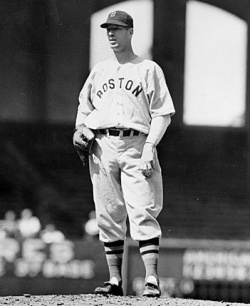
Robert Moses "Lefty" Grove was 41 years old and nearing the end of a brilliant career when he suited up for the 1941 Red Sox. He had gone just 7-6 for Boston the year before, a record which left him seven wins shy of 300. Like Wake, Grove had a great lineup behind him featuring Hall of Famers Ted Williams, Jimmie Foxx, Bobby Doerr, and Joe Cronin, and although he had next to nothing left on his fastball, he started off strong and notched victory No. 299 at Philadelphia on July 3.

The All-Star Game at Detroit interrupted Lefty's quest, but the southpaw seemed poised to reach the magic circle when Boston faced the Tigers in Motor City on July 11. Amazingly, just 4,083 were on hand at Briggs Stadium, and they saw a great duel between Lefty and Bobo Newsome of the Tigers. Both pitchers hurled complete-game six-hitters, but Newsome got slightly stronger support in a 2-0 win. Grove, famous for his surly disposition in defeat, likely knocked around a few things after this one.

Lefty's next chance came at Chicago on July 18, and again he pitched well enough to win -- allowing just two earned runs in a complete-game effort against the White Sox. Unfortunately, errors by Foxx and outfielder Lou Finney led to two more tallies and a 4-3 White Sox win. Sportswriters and fans pondered whether "Old Man Grove" would ever get the big one.

Before Grove next took the hill on July 25 at Fenway against the Indians, manager Cronin told him "Pop, this is a nine-inning game. I'm not taking coming out to get you." As a Friday afternoon crowd of about 10,000 watched on, the visitors took a 4-0 lead after three innings, but Cronin was true to his word. Grove kept battling, and eventually the Sox came back to win with a four-run seventh -- the key hit a two-run triple by Lefty's best buddy, Foxx. The old man pitched a complete-game 12-hitter.

Just the 12th 300-game winner in history, Grove took the game ball for safekeeping, as he had from each of his previous 299 big-league victories. Cooperstown requested it, however, so Lefty obliged -- and with his set now broken up, gave out the other 299 to kids around his neighborhood.  He never won another game, and retired after the season.

Fans hope Wakefield has at least eight victories left in his rubber arm -- enough to overtake Cy Young and Roger Clemens atop the list of Boston's all-time winners -- but right now they'd settle for just one. Next stop on the Wake Watch: Texas on Thursday.


Show all
  

Saturday, August 13, 2011

Blood on the Diamond

The scary incident last night in which Jarrod Saltalamacchia hit a hard one-hopper off Seattle first baseman Justin Smoak's face -- leaving Smoak with a broken nose and potentially more injuries -- got me thinking about moments in which blood has been spilled on the Fenway diamond in this manner.

One jumps immediately to mind. On Sept. 8, 2000, I was watching the Sox-Yankees game on TV when Red Sox reliever Bryce Florie was hit flush in the face by a Ryan Thompson line drive. Florie went down in a heap behind the mound, and scenes of his bloodied, stunned face (he suffered multiple broken bones and a severely damaged eye) were played over and over on ESPN and NESN during the next several days.

 Florie, to his credit, returned to pitch in Boston the next year, but he was ineffective and released in August. He never pitched in the majors again, but he also didn't gave up, hanging on in the minors for several effective years. Here's a nice video about his last comeback, for the '07 Macon Music of the Independent League (Warning: there is footage of his 2000 injury): http://youtu.be/hW9rqT5st1M


Of course the other big one people think of is Tony C. It's been described in countless books including mine so I'll just reflect on it a bit here. I interviewed Billy Conigliaro for Fenway Centennial, and he told me that the entire family was at the August 18, 1967 game when his big brother and future Red Sox teammate was struck by a Jack Hamilton pitch. I had always assumed that everybody knew right away how serious the injury was, but Billy's memory indicates this was not the case. "He got hit all the time," explained Billy C. of Tony, who crowded the plate. "We just figured he'd get up and brush it off like he always did." Tony did get back up, with brilliant results, but it  took a lot longer this time -- his next game at Fenway was in April of '69.


Another near-fatal incident started on the Fenway diamond but wound up in the stands. On August 7, 1982, Boston first baseman Dave Stapleton hit a foul ball into the second row of box seats by the Red Sox dugout that struck 4-year-old Jonathan Keane of Greenland, NH in the head. It was apparent very quickly that Keane needed help, and it came from an unexpected source. Rice sprinted into the stands, grabbed the boy, and ran carrying him into the Red Sox clubhouse --  where Keane was examined by team physician Arthur Pappas and then loaded into an ambulance headed for Children's Hospital Boston in two minutes. Rice played the rest of the game with blood on his jersey, and responded to reporters' inquiries after the game by posing his own question: "If it was your kid, what would you do?"

Keane suffered a lacerated skull and a laceration over his left eye, but in time he recovered and returned to Fenway to throw out the first pitch at a later game (with Rice at his side). Pappas credited Rice's cool head and quick actions for saving the boy's life, and all who saw the drama unfold had one more reason to respect the future Hall of Fame slugger.

Were you at any of these games? Have your own scary Fenway memory to share? Let's hear about them.

Sunday, August 7, 2011

Is Jacoby the new Lynn...or the new Nomar?

It's official. Not counting Kevin Youkilis -- who has a one-of-a-kind cheer -- the Red Sox player getting the loudest and longest applause from Fenway crowds these days is Jacoby Ellsbury.

Yesterday, after picking up their "HELP US OBI-WAN JACOBY!" K cards outside the park, fans serenaded their newest idol with raucous applause as he led off the bottom of the first against CC Sabathia. Ellsbury answered with a fly out to deep right, but by the end of the day he would have six RBI besides his name on my scorecard. Twice in the game, first with a three-run homer off Sabathia in the third and then with a two-run single in the eighth, he gave the Red Sox the breathing room they needed to re-tie the Yankees atop the AL East. In his last two at-bats, fans greeted the sweet-swinger speedster with standing ovations.

Fans, bloggers, and sportswriters are justifiably gushing over Ellsbury's breakthrough season, which now has him on pace to finish with nearly 30 homers and more than 100 RBI from the leadoff spot. Dan Shaughnessy called him "the new Fred Lynn" in today's Boston Globe, but as much as I loved watching Lynn at Fenway, I think a much more apt comparison for Ellsbury's 2011 production would be the rookie season of another leadoff guy everybody seems to have forgotten: Nomar Garciaparra.

Look it up. Before he was moved down to the middle of the order, Nomar batted first for Boston in 152 of his 153 games played during 1997. The American League Rookie of the Year set a MLB record with 98 RBI from the top spot, and led the AL with 209 hits and 11 triples. He finished second on the club (behind Mo Vaughn) with 30 homers, and also had 122 runs scored, 44 doubles, and a .306 average -- all figures right in line with Ellsbuy's current pace. And while he was never in Jacoby's class as a base stealer, Garciappara managed to swipe 22 that year.

The two seasons almost mirror each other (except for triples), yet I have not seen one reference made to Nomar's rookie year when assessing Ellsbury. Perhaps the Lynn comparisons are more logical from a purely visual standpoint -- given both men are movie star handsome and roam the Fenway outfield -- but in terms of sheer numbers and their spot in the order, it is the freshman campaign of Boston's former iconic shortstop which serves as the best reference point. Besides, you need only hear the first name of Nomar or Jacoby to identify them; you can't say that about a guy named Fred.

Does Ellsbury have two batting titles in his future? Will he become the face of the franchise like Garciaparra? Only time will tell; for now, fans can enjoy watching a terrific season continue unfolding.

Saturday, August 6, 2011

Go the F*ck to Sleep – After “Sox in 2”

               Like countless other night owls and insomniacs, I had taken advantage of NESN’s “Sox in 2” feature numerous times before this morning. There had always been one caveat, however: I knew the final score.
 I enjoyed watching a game in the timeframe the architects of baseball had intended – two hours or less – but either before or during the rebroadcast I had already learned the end result. Whether I watched or listened in “real time” or caught the final score on the news or net, there was no mystery waiting for me at 2 a.m. This allowed me to channel surf with no concerns I’d miss something magic like the time I saw word of Carl Yastrzemski’s 3,000th hit come scrolling along the bottom of a long-forgotten sitcom (Happy Days? Laverne and Shirley?) after I had badly timed a surfing session – or maybe you’d call it a dial-twist -- back in September of ’79.

But last night was different. When I went into my daughter’s room to read a few pages of “Judy Moody” around 9:50 p.m., the Sox trailed the Yankees 3-2 in the bottom of the seventh. After several pleas of “just one more page” I managed to get her light off and then promptly fell asleep at the foot of her bed. By the time I awoke it was 11:56 p.m. and I went to check redsox.com for the final score from Fenway. Then I stopped myself. What if I actually watched “Sox in 2” all the way through without knowing the final score? Could I do it? I vowed to try.
Hunkering down in front of my bedroom flat screen with the volume down low (sleeping wife) and a pile of unread magazines at my feet, I breezed through the first six familiar innings with a little surfing thrown in (the last 30 minutes of “Secretariat” – another case where I knew the ending). I started paying more attention in the seventh, of course, and as the Sox tried to break through against the New York bullpen and Steven Tyler adjusted his ridiculous cowboy hat for the umpteenth time from behind home plate, I stopped myself just before checking my iPhone for emails and started congratulating myself for a job well done. I was going to make it to the end clueless and content.
Then, in the top of the ninth, I made a cardinal sin of “Sox in 2” mystery viewing – I looked at the clock. It was 1:51 a.m. when Russell Martin flew out to Crawford for New York’s third out, and by the time the Sox came up against Rivera it was already 1:53 and counting. I knew based on the timeframe that this game was not going into extra innings – in fact, it was likely the Sox were going to go down quickly or win in dramatic fashion. There was no time for any other conclusion; the show was going to be over in seven minutes, and even a series of singles off the Sandman would take longer than that. But while some of the mystery had been revealed, watching the DVD clock just below the screen actually added another layer of excitement to the proceedings. If the Sox were destined to win on a walk-off, who would deliver it – and how?


Papi grounded out, but then Crawford reached on an infield single. 1:56. Salty was called out on strikes. 1:58. Reddick stepped in and I thought, “OK, this is it. He has to either homer or get out. Nothing else fit the timeframe. One strike. Two strikes. I leaned forward as Rivera leaned back, and there it was at 1:59… a called third strike.

Things didn’t turn out like I wanted, but I was still proud of my efforts. I felt like calling my brother-in-law, who has made a fall ritual of DVR-ing Michigan football games, avoiding all electronic and human contact, and then watching the Wolverines in peace and commerical free after his three kids have finished their Saturday slew of soccer games or other activities. I thought back to the summer of 1997 when I had concert tickets in town the same night as Roger Clemens’ return to Boston with the Blue Jays. I put in a video cassette and went to the show (long since forgotten), figuring I would have another great performance to watch when I got home. I had a momentary shock around 10:00 when Dan Shaughnessy walked in and sat down a row in front of me; knowing he must have come from Fenway, I avoided looking at him lest his facial expressions or lips give a clue to what had transpired. What he actually recognized me and said hello, I quickly yelled, “Don’t say anything, Dan!” and he smiled. He must have known what I was up to.
 And after a radio-free drive home, I made some popcorn, sat down, and watched the Rocket mow down his old teammates. After Clemens fanned Mo Vaughn to give him 16 Ks through 8 innings, I grabbed the phone to call a buddy I knew was watching until I realized it was 2:30 in the morning. Ah, there is a kink in the system – you have to have a friend watching “Sox in 2” to enjoy any mid-game analysis by phone or text.
I won’t be needing “Sox in 2” today, as I’ll be over at Fenway watching the Sox try and even things atop the East against Sabbathia. But with a babysitter due at 7:00 and my wife making dinner plans, I am kind of hoping that Lackey and Co. can speed things up a bit without the magic of video.  
Thursday, July 28, 2011

Why We Cheer Wake -- in Good Times and Bad

In addition to being a perfect post-heatwave afternoon at Fenway, Sunday's Red Sox-Mariners matchup gave fans several opportunities to cheer on the most popular 65 mph pitcher in team history: Tim Wakefield.

The knuckleballer received ovations when his face was flashed on the centerfield scoreboard during bullpen warmups, when he started the game with a nifty play on an Ichiro grounder, and when he fanned Mike Carp to end the sixth inning for his 2,000th strikeout with Boston. The only other guy to whiff that many for Boston was the "K Man" himself, Roger Clemens, and fans would not stop screaming until the reluctant hero emerged from the dugout for a brief curtain call.

Perhaps the most telling cheers of the afternoon, however, came when Wake was removed from the game an inning later. He had given up three consecutive singles with two outs in the seventh, then allowed a towering grand slam over the Green Monster to the immortal Brendan Ryan. Boston's lead had been sliced from a laughable 11-3 to a not-such-a-sure-thing 11-7, and Tito had no choice but to take out the 44-year-old righty. As Wakefield started his slow walk back to the dugout, the clapping started low and built to a pitch that matched anything heard after the previous inning's milestone. Sheepishly, he tipped his hat again just before reaching the steps.

As I joined in the reverie from my third base seats, I couldn't help but be reminded of another time when Wakefield earned accolades for a less-than-perfect performance. On the windy, chilly, miserable night of Oct. 16, 2004, when the Red Sox were in the midst of a brutal 19-8 loss to the Yankees that brought them to the brink of ALCS elimination, it was Wakefield who "took one for the team" and allowed five runs in a fast-emptying Fenway while the rest of the bullpen rested. The applause we gave him that night was more subdued, for sure, but offered up with no less respect or gratitude. And in the end, of course, Wake's act of self-sacrifice allowed the Sox to trot out several strong arms over the next two extra-inning contests and begin their Comeback for the Ages.

Is Tim Wakefield one of the best pitchers in Red Sox history? Certainly not. Has he been one of the most valuable members of the club since the Clinton administration? Absolutely. Whether spot-starting, long relieving, jumping into a regular rotation spot, or even closing (remember that?), he goes wherever he is needed and gives the team innings and effort. Whether or not he gets the 7 wins he needs to catch Clemens and Cy Young atop the franchise leaderboard is immaterial; the guy who is the MVP of the Jimmy Fund Clinic and the first Boston player to earn the coveted Roberto Clemente Award for "representing the game of baseball through sportsmanship, community involvement, and positive contributions to [his] club" is someone you are proud to root for. These days in sports, that's not so easy to find.

And that's why we cheer him, no matter the outcome. Wake is a guy you'd like in your foxhole.

Do you have a favorite Wakefield moment? Let's hear about it.


Wednesday, July 20, 2011

1 to 15 to 2...You ain't seen nothing!

The last few games have been as up-and-down as they come for Boston's bats. One night the Sox get five hits and one run over 16 innings, the next they get 15 runs and 16 hits, and then they slide back down to two runs against what is arguably the worst team in the majors. But this type of roller-coaster is nothing compared to what transpired at Fenway one week in 1950.


Ironically, the Red Sox were squaring off from June 6-8 of '50 with the predecessors of today's Orioles -- the St. Louis Browns. Owner Bill Veeck's club was the perennial celler-dweller of the American League, and Veeck was so desperate for patrons and press while playing in the shadow of Stan Musial's Cardinals that a year later he would send 3-foot-7-inch Eddie Gaedel up to the plate as a pinch-hitter. There were no "little people" on the 1950 Browns, but the Sox still had their way with them -- winning the first two games of the weekday series by scores of 20-4 and 29-4.

Boston had a devastating lineup including Ted Williams, Vern Stephens, Bobby Doerr, Dom DiMaggio, Johnny Pesky, and Billy Goodman that was enroute to compiling an incredible .302 team batting average, but this was unlike anything the Fenway Faithful had seen before. The 49 runs and 51 hits the Sox collected in the first two games of the series set major league records, as did the 29 runs and 60 total bases in the June 7 contest alone. Boston had been white-hot in the week before the Browns came to town, scoring 11 runs in consecutive games against the Indians and 17 and 12 against the White Sox. If ever there was a time to bet your paycheck on the home team, it would seem to be for the June 8 finale. It was "getaway day" for St. Louis, and it's hard to imagine a team wanting to get away more. (In 1954, in fact, they'd leave the midwest altogether and move to Baltimore.)


It only took three batters and a Williams homer for Boston to build a 2-0 lead against Browns starter Ned Garver, and the Sox led 4-1 after three innings. But Garver was a better pitcher than his team deserved -- he would be the first hurler to win 20 games for a last-place, 100-loss club the next year -- and he gutted it out through seven innings and helped his teammates earn back some of their dignity with a 12-7 victory. Ned even hit a home run, and the loss seemed to have a damning effect on the Sox. They dropped eight of their next nine games, including a four-game stretch in which they scored just five runs.

What does it all mean? Don't count your runs before they go up on the Wall, or as Yogi Berra would say:  "In baseball you don't know nothing!"

Thursday, July 14, 2011

How I lost my girlfriend to Dwight Gooden: a cautionary All-Star Game tale

From the BR Archives

It was July of 1984, and the first Red Sox team of my lifetime without Carl Yastrzemski in its lineup was struggling along at under .500 and nearly 20 games behind the Tigers. By the All-Star break it was clear that the Sox had no shot in the AL East, but my mind wasn't really on baseball anyway.

This was shaping up to be the best summer of my life. A few months before I had turned 17 and gotten my driver's license, and my brother had bequeathed me his beloved 1973 Olds Delta 88 convertible. Despite rusting floorboards and a leaky roof, this royal blue behemoth  was among the coolest and most recognizable cars  at Newton North High School. I dubbed it The Cruising Vessel in deference to "Fast Times at Ridgemont High," and felt sure it would land me a girlfriend just like Brad Hamilton's. I was far from the coolest guy on campus -- picture a mop-topped Ben Stiller in the early scenes  of "Something About Mary," but the car gave me a new found confidence that would quickly pay dividends.

Driving home one day just before school let out in June, my buddy Marc and I passed two girls we recognized as among the best-looking sophomores in school. We asked them if they wanted a ride home, and this being The Cruising Vessel they naturally jumped right in. A few days later we took them out for a Saturday night drive, and the car worked its magic. This was the first time I had ever dated a girl from my own school, and I envisioned several months of summer bliss followed by a triumphant senior year of walking down halls hand-in-hand with the lovely Miss X.

While I was daydreaming about kissing in the corridors, another teenager just a couple years out of high school was blazing his way across a much bigger stage. Mets rookie Dwight Gooden was striking out batters at a rate no 19-year-old (or few pitchers of any age) had approached before. By the break he already had  133 whiffs in just 111 innings, and nobody was surprised when he was named to the National League All-Star squad. I was aware of Gooden's feats but did not plan to see him perform n the Mid-Summer Classic; my mother was going to be away for the night, and Miss X and I would have the house to ourselves.

Then it happened. Somewhere in the middle of a marathon makeout session I reverted to my Stiller-esque awkwardness and felt a compulsion to reach for the remote and turn on the game. Maybe I was nervous about trying to work my way around the bases (I was mostly a singles hitter at this point), or maybe I just wanted a brief respite before I continued blazing my way to manhood. But when the old Zenith warmed up and I saw the thin, pinstripped Gooden striding the mound, I momentarily forgot all about Miss X and watched the Doc do his thing. When Gooden struck out Lance Parrish, the play-by-play broadcaster (it wasn't Phil Rizzuto, but it should have been given the situation) informed us that NL pitchers had now fanned four straight batters -- Fernando Valenzuela having struck out the side in the previous inning.

After Gooden punched out Chet Lemon, references were being made to Carl Hubbell's five straight strikeouts in the 1935 All-Star Game. Granted, Parrish, Lemon, and the next guy up (Al Davis) were no Boggs, Brett, and Carew, but this was still a little piece of baseball history in the making. Gooden bore down, I leaned forward, and when Davis swung and missed for strike three I pumped my fist and spun around. That's when I noticed Miss X, the smile gone from her beautiful face and her eyebrows raised in what could only be interpreted as polite bafflement. I quickly switched off the game, but it was too late. The mood was gone, and not even Lionel Richie was going to bring it back. When I dropped her off that night I got a peck on the cheek, and a few days later the game was over. My September dreams were dashed.

Gooden would haunt me again a few years later when his Mets did in the Red Sox in the World Series, but by this point I had learned my lesson. Until I had either sealed the deal or knew a girl was a bonafide baseball fan, I was keeping my clicker in my pocket no matter how big the game.