Saturday, January 19, 2013

Clay and Jon Had Better Be On


Jon Lester has a lot to prove in 2013.

The fate of the 2013 Red Sox may very well lay in two sets of statistics:

Pitcher/Wins-Losses/WHIP/ERA
Jon Lester: 33-15, 1.19, 3.17
Clay Buchholz: 23-10, 1.233, 2.70

Lester: 9-14, 1.383, 4.82
Buchholz: 11-8, 1.326, 4.56

The first numbers cover the period from April 2010 through August 2011, when Lester and Buchholz were two of the best starting pitchers in the American League. "WHIP" -- walks plus hits per innings pitched -- has become a popular measuring stick for effectiveness.
Buchholz -- like Lester -- has a no-hitter for Boston.

Below those are what the duo has done since, as they and their team have come crashing to earth. Both were key factors in the 7-20 free-fall of September '11 that cost manager Terry Francona his job -- Buchholz through injury, Lester by ineffectiveness. It was hoped new man Bobby Valentine could spark a turnaround in the pair, but their travails continued on the dismal last-place club that finished 69-93  in Valentine's lone Boston summer of 2012.

Which Lester and Buchholz will we see this year atop the Red Sox rotation? Therein lies the key to new manager John Farrell's staff.

Ownership is hoping that the return of Farrell to Boston -- where, under his tutelage as pitching coach, the left-handed Lester (19-9) and right-handed Buchholz (17-7) flourished as All-Stars in 2010 -- will coincide with a return to form by these hurlers. Both are still in their prime, and if they can regain their co-ace status the Red Sox can take a huge step back toward respectability in the AL East. In Buchholz's case, this also means bouncing back from back problems that sidelined him during last year's second half.
John Farrell believes he'll get both aces on track.

"We feel they are some very tangible adjustments Jon Lester can incorporate to back on track. Clay Buchholz same way," Farrell told the crowd at a Hot Stove event on Cape Cod earlier this month. The new skipper isn't saying what those alterations are, but you can bet it's not a new chicken wing recipe.

Beyond these two, the rotation is even less predictable -- and potentially hazardous.

New No. 3 man Ryan Dempster pitched worse than Lester and Buchholz in the second half of 2012, compiling a 5.09 ERA and 1.453 WHIP for the Rangers after a terrific first half (2.25/1.038) with the Cubs. Dempster had several decent years in the National League with the Cubs and Marlins, but the offensive firepower he'll regularly face in the AL East will test his mettle.

Dempster's past doings against the division -- mostly in inter-league games -- are not encouraging. The 35-year-old has a lifetime ERA of 5.27 versus Toronto and 7.62 (with an 0-4 record) against the Yankees. If that trend continues the Green Monster at Fenway could have quite a few more dents by summer's end.
Can Doubront do it for a full season?

Felix Doubront was one of the few positive stories on the 2012 Red Sox, He went 11-10 in his first full season, and for much of the year was the team's most reliable starter. He slipped badly (1-5, 6.04 ERA) in August-September, but is still just 24. He had an excellent strikeout-to-innings pitched ratio of 9.3, and management hopes another year of experience will bring increased consistency and durability.

The hopes for Jon Lackey -- well, that's another story. His travails since signing a five-year, $82.5 million contract with the Red Sox after the 2009 season are well-documented, as his deceivingly decent 26-23 record in 2010-11 was accompanied by some of the worst ERA/WHIP numbers for a 150-inning starter -- 6.41/1.619 in '11 alone! -- in MLB history.

Lackey missed last year after having Tommy John surgery, but insists he now feels better than ever. Snce his pre-Red Sox resume included a 19-9 season and several big postseason wins for the Angels, one could be encouraged by such talk. Of course feeling good and pitching well don't always go hand-in-hand, and Lackey is not being counted on for much.
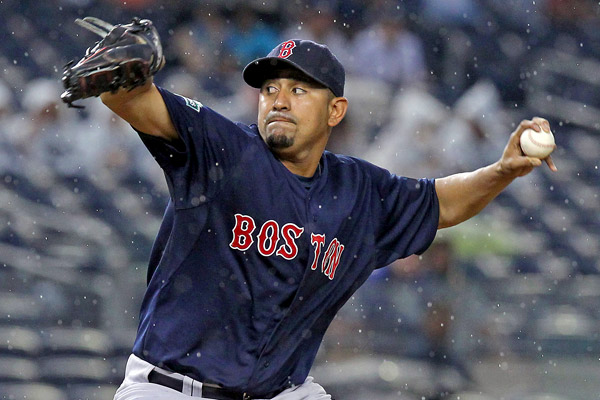
Rain or shine, Morales was solid for the Sox.

Middle relief was busy on last year's club, when no Boston starter had more than 11 wins. Franklin Morales, Craig Breslow, and Junichi Tazawa, all standouts in 2012, are slated to return. Morales, a left-hander, can also start.

The experiment to turn excellent set-up man Daniel Bard into a starter in '12 was a disaster, and the hope is that Bard can shake off memories of last summer's minor league demotion and regain some of his old form in the bullpen. Oft-injured Andrew Bailey was likewise a major disappointment as last year's closer, and this forced Valentine to turn to Alfredo Aceves at the end of games. Aceves did nothing to make fans forget departed stopper Jonathan Papelbon.

Now management hopes the recently-acquired Joel Hanrahan can do so. Hanrahan was an All-Star the last two summers with the Pirates, notching a combined 76 saves, 2.24 ERA, and 128 strikeouts over 128 innings. Bailey will be counted on to fill Bard's old eighth-inning spot, and if Hanrahan falters as closer perhaps Bailey can assume the role he once handled very effectively with Oakland.
Joel Hanrahan: The answer at the end?  

Of course for the closer to even matter, Boston has to be in position to win far more games that last year -- and that all starts with Lester and Buchholz.

Wednesday, January 16, 2013

Jason solves the riddle of the Fenway Double Rainbow

One of several different shots of the Fenway "Double Rainbow"


By Guest Blogger Jason Alpert-Wisnia

In 2000, my dad Saul got an email from a friend with an amazing photo of a double rainbow the friend had taken during a Red Sox game at Fenway Park. My dad was at the game too, and many fans who were there took photos similar to the one he received. Soon the internet was filled with them.


(If you don’t understand or know what a “Double Rainbow” is, here is a link to the original YouTube video that started the trend.It's by Hungrybear9562.) Make sure you play the audio.
The original viral video of "A Double Rainbow"

Now, 13 years later, my father still had the photo and was using it as desktop wallpaper on his computer. He had forgotten, however, when it was taken, who was playing the Red Sox, who was batting, and all the other information about this amazing photograph. On the old JumboTron scoreboard at Fenway you can see the number 20 (or maybe 10) faintly, and the other words and numbers are fuzzy too. Also, it’s hard to tell who’s batting (the Red Sox or the visiting team) because all the uniforms seem the same shade of white.

We thought it would be fun to figure out this mystery. 


We Googled “Double Rainbow over Fenway Park Photo." One of the first links was to a company selling the photo: http://www.nytstore.com/1/1/4413-fenway-park-rainbows-2000-nsap568.html The ad stated that the picture was taken during “July 2000” when the Red Sox were playing the Atlanta Braves, both facts which my dad had forgotten. But there was one downfall; it did not state the exact date.

So we went to http://www.baseball-reference.com, and looked up the 2000 Red Sox. We then went into the season schedule for the month of July. We looked over the games for any dates when they played the Braves at Fenway; they met the Braves on July 8th and 9th. We then looked over the Red Sox’s lineup for those games, because we were pretty sure they were the team batting in the picture. 


We were wrong! None of the players on the Red Sox roster that year wore the number 20.

We then looked over the Braves lineup for the same two games. None of them had the number 20 either. So we decided that maybe it was number 10. The only player on either team's roster for those two games 
who wore the number 10 was Chipper Jones.
The view from dad's desk.


Mystery solved? Not so fast. 

In the original photo, the first name of the player on the scoreboard looked too short to be "Chipper," but when we enlarged the picture we realized the player actually had on a Red Sox cap .

How could this be?


We went back over the season schedule, and noticed we had missed a game against the Braves on July 7th!


Looking at the Red Sox lineup for THIS game, I found the perfect match. The starting catcher on July 7th was Scott Hatteberg, and he wore number 10 on the Red Sox for all of 2000.

Now that we knew the batter, we decided to go deeper into the mystery. We wanted to know what inning he was batting in, and against what pitcher.


Scott Hatteberg -- he's our man.


I looked up the pitchers who played for the Braves in that game, and they were Tom Glavine, John Rocker, and Kerry Ligtenberg. Going over the inning-by-inning linescore, we saw that Hatteberg batted in the bottom of the 2nd, as the third batter, and struck out against Glavine. He also came up in the bottom of the 5th, and hit a ground ball out off Glavine.


In the photo you can see that there is a player on first base. I looked closer at the bottom of the 2nd to see if someone had reached first. The first batter, Ed Sprauge, walked. Then the next batter before Hatteberg, Manny Alexander, had hit a fly ball out to right field. So Hatteberg's first time at bat, there was indeed someone on first base. His second time up he led off the inning, so that would not work.

So, in my dad's screensaver photo and the many other double rainbow shots matching it, Scott Hatteberg is batting against Tom Glavine and the Atlanta Braves on July 7th, during the bottom of the 2nd inning.

Mystery solved!


Did the double rainbow's luck come four years later?


Friday, January 11, 2013

Roger Clemens: A cardboard God comes into focus


The picture stands today as the symbol of an era -- and innocence -- lost.

In it, Roger Clemens and Ted Williams share confident, youthful smiles. Williams is, quite literally, a bronzed God, staring out at the photographer in his tanned, All-American glory. Clemens, wearing a fresh, clean Red Sox uniform, also has the look of a man who knows exactly what he wants out of life.

Williams yearned to be the world's greatest hitter; Clemens the top pitcher. At the time of the picture, in 1988, both had reached their goal.

I took the photo in Cooperstown, after driving from Boston to baseball's Mayberry with three buddies for my first look at the game's red-bricked shrine. When we entered the Hall of Fame Plaque Gallery, just off the museum's lobby, I instinctively knew which of the immortals I wanted to visit first. Walking through the years to the 1966 induction class, I found him on the wall right alongside Casey Stengel: 

THEODORE SAMUEL WILLIAMS
"TED"
BOSTON RED SOX A.L. 1939 - 1960

Reaching into my pocket, I grabbed the '87 Topps Roger Clemens card I had taken on my journey. Quickly placing it atop the upper-right corner of Ted's plaque, I jwhipped out my camera, took a single shot, and then pulled the card down before I could be caught and thrown out for legend-tampering.
Ted the bronze God

There was no digital screen on my little Kodak to tell me whether I had muffed the picture, but I wasn't going to take a chance at a second one. I just hoped for the best and went on my way.

Clemens was coming off back-to-back Cy Young seasons for the Red Sox, and appeared poised to become the Tom Seaver of his generation. Williams was the real John Wayne, the last man to hit .400 and a war hero whose #9 I always looked for first in the right-field corner upon entering Fenway Park. Both had iconic nicknames that suited them and stuck; Ted was "The Kid" and the "Splendid Splinter," Clemens the "Rocket."

When I bought this scorebook, Clemens was 14-0.

I had only seen Williams hit live in an Old-Timer's Game, but I had been watching Clemens up close since his rookie year. He was 25, I was 20, and I looked forward to many more Rocket sightings in my Fenway future.

As an aspiring sportswriter, I even had visions of seeing some of them from the press box. Then, when Clemens made the Hall of Fame, I'd show him the old picture I'd taken way back when and we'd share a laugh. Maybe I'd have him sign it for my kid.

Things didn't turn out quite as expected. By 1996 Clemens had amassed a list of achievements for the Red Sox that had him comfortably headed for his own Cooperstown plaque, but had slumped in recent years.

He still had the gas and skill to strike out 20 (with no walks) at Tiger Stadium that September, however, and few weeks later I saw him pitch another strong game at home against the Yankees. Rumors were he would be ditching the Sox as a free agent that winter, and I  joined in a long standing ovation when he left the game and tipped his cap.
My ticket from Clemens' last game with Boston.

We knew it might be the last time he pitched for the Red Sox, and it was -- Clemens heading to Toronto to prove Sox GM Dan Duquette he was not past his prime at 34. He accomplished the task with back-to-back Cy Young, Triple Crown seasons, and when the first whispers of steroids started I tried to shut them out. Barry Bonds and Mark McGwire could be juicers, sure, but the Rocket? He had always seemed like the real deal, a throwback to another era.

Later, when I traded in my sportswriter's cap for a writing job at Dana-Farber Cancer Institute, I learned Clemens had even made a ritual of jogging over to the Institute's pediatric Jimmy Fund Clinic in uniform to visit sick kids. It was something that would have made Ted Williams -- the king of Jimmy Fund heroes -- happy as all hell. 

How could Clemens risk a chance to join the Splendid Splinter among Boston's greatest all-time icons?

They still never proved anything in court, of course, but Clemens now sits right alongside Bonds as the poster boys for the steroid era. The fact the Rocket denied any juicing doesn't seem to make a difference; the damning testimony of his former trainer in the perjury trial brought against Clemens has made him guilty in the court of public opinion -- and the minds of many Hall of Fame voters.
Without a glove and ball, Clemens looks lost.

The man whose 354 wins and record seven Cy Young Awards places him statistically in the pantheon of Seaver, Walter Johnson, and the other greatest pitchers in baseball history received just 36.2 percent of the vote in his first crack at Cooperstown. Although 75 percent is needed for admission, the general consensus is that Clemens will eventually make it. Still, he'll forever be tainted by the evidence and the era.

Certainly I've come around to accepting his probable guilt, tempered only by the likelihood that he first started juicing after he left Boston -- meaning those games I saw him pitch from '84 to '96 were the result of nasty stuff and not needles.

As for the picture, I did flub it after all. In my frenzy to capture the moment it had turned out blurry and a bit over-exposed. You could still tell who Clemens and Williams were, you could still see their smiles, but everything was out of focus. I didn't realize when I opened the envelope from CVS and saw the fuzzy photo just how prophetic it would be. 

My search for the picture proved futile.

Wednesday, after the Hall of Fame voting became public, I went looking for it in a shoe box of old high school and college-era pictures. I found a bunch from my second Cooperstown visit, but none from the first -- including the Williams-Clemens shot. It was just as well.

By now, everything was in clear view. 


Sunday, January 6, 2013

Projected Red Sox lineup: too many questions for comfort?

Will Victorino help point the way out of the cellar?

It has become trendy in recent weeks for experts to declare the Red Sox not only big players during the recent flurry of off-season transactions, but also big winners.

This may be wishful thinking, however, since it's hard to imagine another season as dreadful as the 69-93 last-place debacle of 2012. It's true Boston picked up strong character guys in Shane Victorino and Johnny Gomes, along with a few streaky power-hitter types in Stephen Drew and Mike Napoli. But the revamped Boston lineup still has plenty of uncertainties with spring training a little over a month away.

Let's take a look around the diamond as things currently stand (projected starters in bold):

At first base the newcomer Napoli, who can also catch, will likely get the nod provided Boston and his agent come to terms over his contract. Health may be an issue; while Napoli hit 24 homers last year and 30 in 2011, he's played more than 114 games just once in seven MLB seasons (140 in 2010). Current backup Mauro Gomez was the International League MVP at Pawtucket last summer, but in 102 at-bats with Boston posted only 2 homers. Mark Hamilton has shown bursts of power in the minors but has hit .197 in two call-ups with St. Louis.
Will dirt-dog Pedroia play himself out of a long career?

Second base remains a strong suit with Dustin Pedroia returning, but while the three-time All-Star and former MVP is still Gold Glove-worthy in the field, his OPS and slugging numbers have dropped off each of the past two seasons. He's also been injury-prone and missed 21 games in 2012. Pedroia will turn 30 in August, an age where he may soon become more prone to breakdowns (think Kevin Youkilis) if he continues playing in his aggressive, dirt-dog style. 

When the Red Sox signed shortstop Stephen Drew to a one-year, $9.5 million contract this winter, it surprised a lot of people who thought all-glove, no-bat Jose Iglesias was going to get a crack at starting in 2013. Iglesias has hit above .235 just once at any level, and checked in at .118 in 68 at-bats for Boston last year. Now it's likely Drew, a veteran who has had some very strong offensive seasons, will get the nod, but he is no sure thing either after a .227 year in which he missed 80-plus games with a severe ankle injury.
Will Middlebrooks fill Youk's big shoes?

Third baseman Will Middlebrooks was perhaps the biggest surprise of the 2012 Red Sox season, as the rookie exploded on the MLB scene with a .331 average and 9 homers in his first 142 at-bats after taking over for injured-then-traded Kevin Youkilis. Middlebrooks eventually reached 15 homers and 54 RBI before being felled for the year by a broken wrist on Aug. 11, numbers that while very impressive marked a considerable drop-off from his torrid start. 

Most expect Middlebrooks to continue growing as a hitter and fielder in 2013, but a sophomore slump can't be ruled out given his .194 September. Fan favorite Pedro Ciriaco, another pleasant surprise in 2012 as Middlebrooks' end-of-year replacement, will be itching to jump in again if the need arises.

In right field Victorino gives the Red Sox Gold Glove-caliber defense, but his offensive numbers (including just 11 homers and 55 RBI last year) look very J.D. Drew-esque. Since J.D.'s  strong fielding was taken for granted and his hitting over-analyzed, it's not too hard to imagine Victorino will start hearing catcalls from Conig's Corner if he doesn't come out swinging strong.


Will Ellsbury rebound -- and stick around?

Center fielder Jacoby Ellsbury was a 32-homer, 39-steal man and MVP runner-up in '11, but had almost no power (4 homers in 303 at-bats) upon returning in mid-2012 from a dislocated shoulder. By not (yet) adding Hamilton or another big-name outfielder to the roster this winter, Sox management appears to be gambling that Ellsbury will bounce back strong in his free agent year and become either blue-chip trade bait or a contract extension candidate late in the summer. His fate likely depends on Boston's place in the AL East and Wild Card races come July.

As a hitter, new left fielder Johny Gomes won't have anybody thinking of Ted, Yaz, Manny, or even Mike Greenwell, but on defense he may remind folks of butchers like Manny and Jose Canseco. Look for Daniel Nava to get the bulk of the reserve at-bats should Gomes or another outfielder falter, with Ryan Kalish, Drew Sutton, and Alex Hassan also in the mix. If Ellsbury is dealt, of course, another starting slot will open up.
Will Mike Napoli supplant/spell Salty as catcher?

At catcher there is a logjam. It's still unclear whether Jarrod Saltalamacchia can be a 140-game-a-year receiver; after setting a 30-homer, .280 pace in the first half of 2012, he was one of the easiest hitters in the AL to strike out down the stretch and finished at .222 with 25 dingers. Doubts about Salty's durability led the Red Sox to sign David Ross (a solid back-up for Atlanta) and likely Napoli (who caught 72 games for Texas last year).

Throw in last year's primary Boston back-up Kelly Shoppach and young Ryan Lavarnway (a standout in the minors who struggled after a second-half call-up), and it's clear this position is anything but set. The chances are at least one of these five catchers -- all of whom could likely start for a big-league team -- will be dealt before spring training.
Will Ortiz be looking up all season? 

Designated hitter David Ortiz provides another big question mark. Not because of the numbers he put up when playing in 2012 -- they were outstanding -- but because of the fact the seven-time All-Star missed 71 of the last 72 games with a Achilles injury and turned 37 in November. Even the svelter version of Big Papi we saw last year is a big-boned, Mo Vaughn/Boomer Scott body type who like these former Sox sluggers could lose his skills in a flash. Management showed its appreciation for Ortiz's place in club history with a new two-year contract; if he manages to keep hitting that long, he also needs to keep healthy.

The concerted effort by Boston GM Ben Cherington and his crew to pursue solid and steady pick-ups rather than A-List superstars like Josh Hamilton should help the Red Sox avoid long-term contract headaches like the Yankees now face with A-Rod. What Ben and Co. must hope is that they have not created a team without enough sure things.

Next week: A look at the pitching staff.

Wednesday, December 26, 2012

Best and worst Red Sox Christmas-time transactions


Can Hanrahan light up Fenway? Time will tell.

Now that it appears the Red Sox have "wrapped up" their big Christmas week trade with the Pirates, it got me thinking about how the Sox have fared in past late-December moves. It's too early to say how this swap is going to shake out; if closer Joel Hanrahan pitches in Boston like he did during most of the past two seasons, he'll be a huge step in the rebuilding effort.

Here's a look back at the success of some other Christmas-time transactions by the Red Sox:

Dec. 28, 2011: Promising outfielder Josh Reddick and minor leaguers Miles Head and Raul Alcantara traded to Oakland for closer Andrew Bailey and outfielder Ryan Sweeney.
Reddick probably doesn't feel this way anymore.

Result: Not looking good so far. Bailey was injured most of the season and ineffective upon his return. The Hanrahan trade makes it pretty clear Sox management believes Bailey won't bounce back strong, and Sweeney was allowed to go to free agency after a lackluster .260, 0-homer year with Boston. As for Reddick, he was one of the biggest MLB surprises of 2012, hitting 32 homers and earning a Gold Glove with the A's. HO-HO-HO Meter -- (1/2 HO)

Dec. 24, 2004: Catcher Jason Varitek re-signed as free agent. 

A direct result of Tek's re-tendering -- another title.

Result: Strong move for two reasons. Although Varitek turned 33 in April 2005, he remained a productive offensive and defensive performer for most of the four-year deal. More importantly, the captain stabilized an ever-evolving pitching staff and helped lead the Red Sox to another World Series title in 2007. (HO-HO-HO)


Dec. 21, 2001: Outfielder Johnny Damon signed as free agent.


What would Johnny do? Plenty for the Sox.

Result: Idiot's delight. Damon delivered in every way for the Red Sox over the four-year contract, as a speedy lead-off man with power, an excellent defensive outfielder (minus his throwing arm), as a tough, enthusiastic leader in the clubhouse, and as a clutch performer in the postseason. His grand slam in Game Seven of the 2004 ALCS is one of the biggest hits in team history. (HO-HO-HO-HO) 

December 19, 2000: Outfielder Manny Ramirez signed as free agent. 
Over 8 years, Sox fans enjoyed Manny happy moments.

Result: Best free-agent signing in team history. Even at eight years and $160 million, Manny was worth it -- teaming with David Ortiz to form a devastating one-two punch and averaging .313/.412/.594 with 36 homers and  114 RBI from 2001-2007 as a major cog on two World Series champions. (HO-HO-HO-HO)

Dec. 22, 1980: Postmark date stamped on a contract mailed to Red Sox catcher Carlton Fisk, two days after a deadline expired -- making Fisk a free agent. 
After switching Sox and his number, Fisk kept hitting.

Result: Holy Cliff Clavin. Fisk signs with the White Sox and over next 13 more seasons hits 214 home runs. (No HOs)

Dec. 26, 1919: Outfielder/pitcher Babe Ruth sold to Yankees for $125,000 plus a $350,00 loan.
Harry Frazee ate crow on this move.

Result:  Owner Harry Frazee's folly. Frazee didn't like Ruth's wild ways, or his demands for a $20,000 contract. So he sent the Babe packing, then watched him hit 659 homers for New York through 1934. (No HOs)

Thursday, December 13, 2012

Toughest Red Sox to see in a Yankees uniform at Fenway


When word of his pending trade broke, Fenway rocked for Youk.

Pending a failed physical or other unforeseen mishap, Kevin Youkilis will be manning third base and wearing pinstripes when the Red Sox open the 2013 season at Yankee Stadium on April 1. Amazingly, it won't be until July 19 that the teams will square off in Boston, giving Fenway Park fans their first chance to see their former favorite son in a New York uniform.

Red Sox Nation had an opportunity to adjust to life with Youk in the visitor's dugout when the White Sox visited Fenway shortly after his trade to Chicago last summer, but this is a much different situation. Boston fans may developed a kinder, gentler hatred for the Yankees since 2004, but there is something about seeing a former Red Sox in enemy colors that still tugs at the heartstrings.

Here's a look back at some of the biggest Boston heroes to wind up in the Bronx -- and how they fared on their Fenway returns.

BABE RUTH
Even in Yankees road duds, Boston loved the Babe.


He's the guy who started it all.

When Red Sox owner Harry Frazee sold his mega-talented problem child to the Yankees for a record $100,000 in cash plus a $300,000 loan in January 1920, he did nothing to change the feelings Boston fans had toward the greatest player of all time. Ruth, Lou Gehrig, and Co. routinely plastered the hapless Red Sox of the '20s and early '30s at Fenway, but the crowds never stopped cheering for the Bambino.

In fact, Fenway routinely drew its biggest crowds during this period when the Yankees came to town. They knew one-of-a-kind talent when they saw it, no matter the uniform. They just wished he was still wearing the right one.


RED RUFFING


Ruffing had little reason to smile with the Sox.

A generation or two of readers might have never heard of this guy, but he's in the Hall of Fame -- and is the pitching equivalent of Babe Ruth when it comes to lost talent sent from Boston to New York.

The sale of Ruth started a wave of activity between Red Sox owner Frazee and his Yankees counterpart Jake Ruppert, who was more than happy to take promising players off Frazee's hands in exchange for cold cash and warm, mostly useless bodies. The 1923 Yankees team that won the World Series had 10 players who had come directly from Boston's roster, and by the time the right-handed Ruffing was swapped to New York for the immortal Cedric Durst and $50,000 in May 1930, the Yanks had started a dynasty and Fenway was a morgue where guys like Red came to pad their stats.

Ruffing celebrated his return to Boston a few weeks after the trade by helping the Yanks to a 3-2 victory. After going 39-96 for Boston, he would go 234-121 with New York plus 7-2 in the World Series. Guess which hat he's wearing on his Hall of Fame plaque?


SPARKY LYLE
They should have kept the other guy with a mustache.

Tom Yawkey purchased the last-place Red Sox in 1933, and apparently learned his lesson from Frazzee and his other predecessors and made trades to the Yankees a rare occurrence. In fact, it wasn't until the winter of 1972 that another swap of significance was made between the teams. 

This one was another stinker.

Sparky Lyle, a left-handed pitcher who had helped the 1967 Red Sox to the pennant as a rookie and became one of the AL's best relievers in the years that followed, was sent to New York for Danny Cater, a first baseman who looked like a used car salesman but always seemed to hit well at Fenway.

The fallout from this one was immediate. Cater hit .237 for Boston in '72 and was out of baseball not long thereafter. Lyle had an AL-best 35 saves his first summer in the Bronx and continued his superb work with the Yanks through six more years -- including a Cy Young season with the 1977 World Series champs. As a child of the Brady Bunch era I don't recall Fenway fans booing him much, but they knew the trade wasn't his fault.


LUIS TIANT
El Tiante -- a Fenway hero in any jersey.

A lot of people forget about this one, but LOOOO-IEE was the first major star to go from the Red Sox to the Yankees as a free agent -- and it didn't hurt his reputation in Boston one bit. 

A cult hero with teammates and fans who always won the big game -- including three of them in the '75 postseason -- the 38-year-old Tiant was offered just a one-year contract by Boston after pitching great down the stretch of a frenzied 1978 pennant race. The Yankees dangled a two-year deal, plus other perks, and just like that one of the most popular and talented players in franchise history was gone.

It doesn't really matter that Tiant's best days were behind him. Seeing him in a Yankee uniform at Fenway was agony. Carl Yastrzemski spoke for all his teammates when he said that when ownership let Looie leave, "they ripped out our heart and soul."

Fans felt the same way. 


WADE BOGGS
At least his Hall of Fame plaque has a "B" cap.

The next marquee name to head from Boston to the Bronx as a free agent was the best pure Red Sox hitter since Ted Williams -- but it was in New York he became a champion.

Third baseman Wade Boggs won five batting titles for the Red Sox, but after hitting .259 in 1992 was deemed expendable. Yanks brass thought he might still have something left, and they were right -- he hit .313 over five years in New York and helped the '96 Bombers to the World Series title. He even won two Gold Gloves, and the reception was usually mixed when he brought his slick hitting and fielding talents to Fenway. 

Boston fans appreciated what he had done for them, but he was still a Yankee.


ROGER CLEMENS
A hug from Papi -- and finally some Fenway cheers.


There was no mixed reaction when it came to Roger Clemens. 

There were two years (1996-97) between when Clemens left Boston as a free agent for Toronto and then moved on to the Yankees, and in that period many Fenway fans actually rooted for Roger when he came to town -- starting with a 16-strikeout performance against his old mates in his first game back. The guy getting the boos that day was the guy who let him walk -- Boston general manager Dan Duquette.

But once Clemens put on a Yankees uniform, the ace who won three Cy Youngs and an MVP with the Red Sox became the most despised man in the ballpark. He was even booed when introduced at the 1999 All-Star Game at Fenway as one of the century's top pitchers, and the anger only got worse when the Rocket helped the Yanks to four pennants and two World Series titles.

Only when more than 15 years had passed and Clemens was voted on to the All-Time Fenway Team in 2012 did he hear cheers at Fenway again -- and there were a few boos in there too. Given his history and the steroid rumors swirling around him, this will likely always be the case. 


JOHNNY DAMON
What a difference a year makes.

First he was Jesus, then he was Judas. That just about sums up the relationship between Boston fans and Johnny Damon.

The tough, fleet center fielder was one of the key players in the Red Sox Miracle of 2004, hitting two home runs (including a grand slam) against the Yankees in Game 7 of the ALCS. He even looked the part of a biblical savior with his shoulder-length hair and long beard.

Then, after another great year in 2005, the star pupil of Scott Boras took the highest offer and signed as a free agent with New York. That's when the "Damon is Judas" tee-shirts started popping up on Yawkey Way, and the moniker seemed even more appropriate when Steinbrenner made Damon cut off his heavy mane and beard. Johnny did get a mixed ovation on his first at-bat at Fenway with the Yanks, but by his second many fans were booing loudly.

Still, deep down it's a good bet many of them were jeering their former rock star hero as part of the newer, more good-natured Red Sox-Yankees rivalry than pure anger. People have a much different feeling toward Damon than they do Clemens and Boggs, Had 1986 not ended as it did, perhaps this would not be the case. But it did.

Damon may have defected, but he still won't ever have to buy a beer in Boston.


KEVIN YOUKILIS


Youk should get another hand like this one next July.

Which brings us back to Youk. Because the Yankees don't come to Boston until July 19-21 next year (what's up with that?) , there is a good chance that the injured Alex Rodriguez will be back manning third base for New York and Youkilis will be in a reserve role. 

Still, it's hard to imagine Youkilis won't get at least one chance to bat during the three-game series, and as he steps to the plate he will almost surely hear the greatest cheers given a Yankee since the ovation for Mariano Rivera on Opening Day, 2005 (in thanks for helping New York blow the ALCS the previous October). 

If Damon got a half-free pass for helping Boston win one World Series, Youkilis will get a full freebie for his part in two championships. Plus, more importantly, it wasn't Youk's choice to leave -- and if most Boston fans had it their way, he and Tito Francona would both still be wearing white at Fenway. 


Thursday, December 6, 2012

Roger Clemens a Hall of Famer? Try the Tom Seaver Test


Young, strong, and Cooperstown bound

Since the list of Hall of Fame nominees was announced last week, I've been pondering whether first-time candidate Roger Clemens would be earn my vote if I had one to give.

The Rocket has undeniable Cooperstown credentials, topped by a record seven Cy Young Awards, the 1986 AL MVP, and 354 victories. He struck out 4,672 batters during his long career, a total topped only by Nolan Ryan and Randy Johnson, and twice had 20-K games in which he didn't walk a single batter. That combination of power and control also helped Clemens lead his league in ERA seven times.

In my memory bank of Red Sox pitchers, which dates to the mid-'70s, only Pedro Martinez resonates as more dominant over a sustained period of time. But while Pedro was a delicate thoroughbred rarely allowed to reach past the seventh inning, Clemens was a good-old-fashioned workhorse who regularly finished what he started.

For more than a decade the Rocket delighted Boston fans with overpowering performances. One of the first came his rookie year of 1984, when he topped the Royals at Fenway with a 15-strikeout, zero-walk effort a few weeks after turning 22. 

Clemens was Topps in '86. 

Five years his junior, and about to enter my final year of high school, I followed the action that sweltering August evening through Ken Coleman's radio account while downing beers and looking out for cops in a concert parking lot. I've long since forgotten the venue and the band my buddies and I were seeing, but can still recall the excitement in Coleman's voice. He knew he was seeing the start of something special.   

In 1986, fully matured and free of the injuries that hampered his first two seasons, the Rocket went full throttle – going 24-4 and nearly pitching the Red Sox to a World Series title. I watched most of the series from a dormitory lounge at Syracuse, surrounded by Mets fans, but with Clemens on the hill their taunts grew quiet. Even the enemy respected him then.

That was the year the “K” cards started popping up at Fenway, and, as with Pedro later on, Yawkey Way had a special electricity when Clemens was scheduled to start. He stayed a winner through the team's myriad ups and downs, and in the days before ESPN.com and smart phones, scanning the morning paper for his pitching line was one of my favorite collegiate pastimes (along with summer pilgrimages to see the Rocket live).

Did Canseco (at right) give Clemens any ideas?

Later, while working late into the night at the Sports desk of The Washington Post, I went high-tech -- scanning for Clemens' name amid the Associated Press game accounts that came across in glowing green on my smoke-stained monitor. By the time I moved back to Boston in 1995, however, the Rocket appeared to be on the descent, his gut expanding along with his ERA.

Pitching for mostly mediocre teams, Clemens was 40-39 from 1993-96. I was at Fenway for his last start of '96, a 4-2 loss to the Yankees in which the pending free agent received a standing ovation when taken out midway through the eighth inning. Even thought it was a meaningless game, we knew based on the acrimonious relationship between Red Sox GM Dan Duquette and his ace that it might be the Rocket's final hurrah for Boston.  

It was. Although Clemens still led the league in strikeouts in 1996 – including his second 20-K gem -- management allowed him to depart to Toronto for what Duquette famously predicted would be “the twilight of his career.”

This is where things get more complicated. A visibly slimmer Clemens rebounded to win back-to-back Cy Young Awards for the Blue Jays, and went on to enjoy several more outstanding seasons for the Yankees and Astros – pitching effectively into his mid-40s and climbing the all-time leader boards in various categories.
Yankee Roger: public enemy No. 1.

But when the steroid scandal rocked baseball around the time of his 2007 retirement, the Rocket's surprising late-career resurgence made him a prime suspect. Thinking back to when I'd don my “Klemens” tee-shirt, buy a standing-room only ticket, and climb atop the railings behind Fenway's upper grandstand seats to see No. 21 perform, I desperately wanted to believe Clemens when he denied any involvement with PEDs during the 2008 Congressional hearings.

Then Clemens' former strength coach Brian McNamee came forward with claims he had injected the pitcher with steroids in 1998, 2000 and 2001, and with human growth hormone in 2000. A perjury case against the Rocket was quickly deemed a mistrial after the prosecution showed jurors inadmissible evidence, but not before one of the needles McNamee had saved for years was found to contain DNA matching that of Clemens. 
Clemens in court: the mighty have fallen

Now back to my mythical vote. Let's assume, given the large pile of damning information, that Clemens did indeed juice it up starting at age 34 in 1997. Since the player he is deemed most statistically comparable to on baseball-reference.com from ages 34-41 is Tom Seaver – whose career, ironically, ended with Boston in the pre-Juice days of 1986 – I thought swapping in Seaver's statistics for Clemens' from 34-41 would be a good way to gauge how the Rocket's career might have gone had he kept on the straight and narrow.

And, since Seaver retired at 41, it's a safe bet that a “clean” Clemens would likely have also hung 'em up rather than continue at less than his best. The real Clemens kept hurling until he was 45, longevity that allowed him to pad his stats and his wallet.


Given Seaver's late-career numbers in place of his own, the Rocket's record drops from 354-184 to a less glittering 279-112, and he winds up with three rather than seven Cy Young Awards. He still strikes out a lot of guys, but ends with closer to 3,800 lifetime whiffs than 4,700. And, like Seaver, he retires at 41.

For half a season, they were teammates.

Is a Clemens with these numbers a Hall of Famer? Probably, especially when you look at his "real" pre-1997 career. Playing exclusively for the Red Sox from 1984-96, the Rocket went 192-111 with 100 complete games, a WHIP of 1.158, and 38 shutouts. Those victory and shutout totals, incidentally, leave him tied atop the all-time Boston leader boards in both categories with Cy Young – the same guy whose name is on all those plaques Clemens earned for pitching excellence.

Whether a 279-win Clemens with no PED rumors is a first-ballot Hall of Famer is up for debate. I don't think so. His peak years may be as good as anyone's, but less lifetime victories than Cooperstown outsiders Jim Kaat and Tommy John should deny him a slam-dunk selection like those afforded Seaver and Ryan.

This might be for the best. Perhaps sweating it out for a few years with low vote totals will help Clemens to recall facts he may have “misremembered” about those needles, and lead to an admission that earns him a clear conscience and a Cooperstown plaque.

A last wave of the cap in '96.

I'll never feel quite the same about the Rocket as I did back in the '80s, but he'll have gained back some of my respect.